
Environment and genetics contribute to the development of the most common form of liver cancer, hepatocellular carcinoma
11 Sep 2026
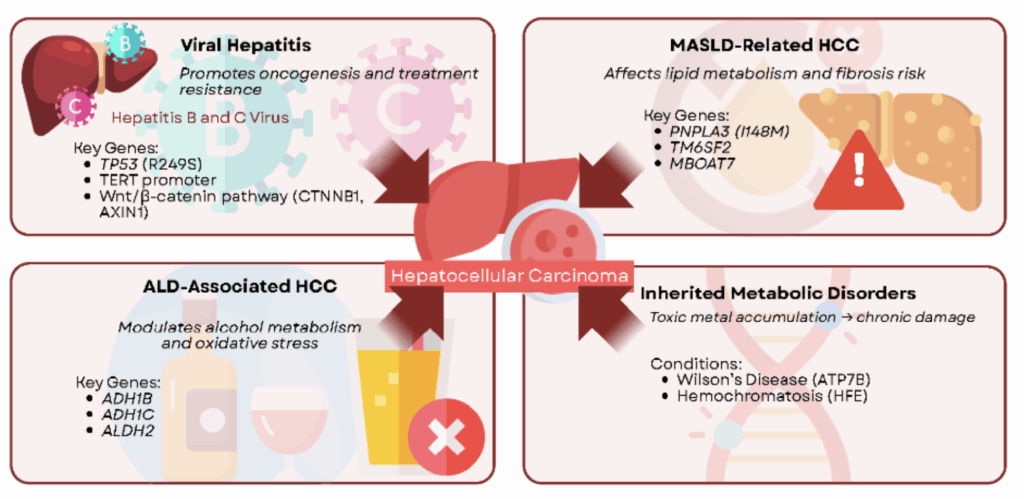
The development of cancers is often attributed to several risk factors, both nature and nurture. Previous studies have identified the environmental risk factors contributing to the development of the most common form of liver cancer—hepatocellular carcinoma—including chronic hepatitis B and C infections, metabolic dysfunction-associated steatotic liver disease, and alcohol-associated liver disease. In terms of nature, there are genetic alterations present within us since birth that predispose us or make us more likely to develop certain types of cancer, or in this case, hepatocellular carcinoma. Medicine is not limited to the provision of generalized interventions; rather, precision medicine helps us identify certain subgroups that are more prone to develop the disease. Hence, increasing access to genetic screening, establishing precision medicine programs, and developing risk prediction models would allow us to identify those who are at risk at an earlier age and prevent the development and progression of the disease.
This study highlights the various genetic variants of precancerous conditions of hepatocellular carcinoma—hepatitis infection, metabolic dysfunction-associated steatotic liver disease, alcohol associated liver disease, and inherited disorders—that were previously identified in recent years. With the advent of precision medicine and its increasing access to the general public, we need to identify how we can further individualize medicine to make it responsive to each patient’s needs. This study also highlights how these findings affect clinical practice and the overall public health setting. The findings inform the need to improve population-level health information systems as well as develop further interventions and research to make precision medicine more accessible.
Authors: Jonathan Jaime G. Guerrero (College of Medicine, University of the Philippines Manila | College of Public Health, University of the Philippines Manila | Graduate Institute of Metabolism and Obesity Sciences, Taipei Medical University), Paolo C. Encarnacion (College of Medicine, University of the Philippines Manila | College of Public Health, University of the Philippines Manila | Department of Industrial Engineering and Management, Yuan Ze University), Mark Angelo S. del Rosario (Department of Biochemistry and Molecular Biology, College of Medicine, University of the Philippines Manila), Matthew Aldren S. Ora (College of Medicine, University of the Philippines Manila), Jiayan Zhou (Department of Medicine, Stanford University School of Medicine), Kin Israel Notarte (Department of Pathology, Johns Hopkins University School of Medicine), Wan-Chun Li (Institute of Oral Biology, College of Dentistry, National Yang Ming Chiao Tung University | Department of Dentistry, College of Dentistry, National Yang Ming Chiao Tung University | Oral Medicine Innovation Center, National Yang Ming Chiao Tung University | Department of Stomatology, Taipei Veterans General Hospital), and Ching-Wen Chang (Graduate Institute of Metabolism and Obesity Sciences, Taipei Medical University | TMU Research Center for Digestive Medicine, Taipei Medical University | Taipei Cancer Center, Taipei Medical University)
Read the full paper: https://doi.org/10.1002/ijc.70092