
Filipinos’ negative views of China mostly stem from national issues, but their opinions toward Chinese individuals in the country are shaped more by local, everyday contexts
18 Sep 2026
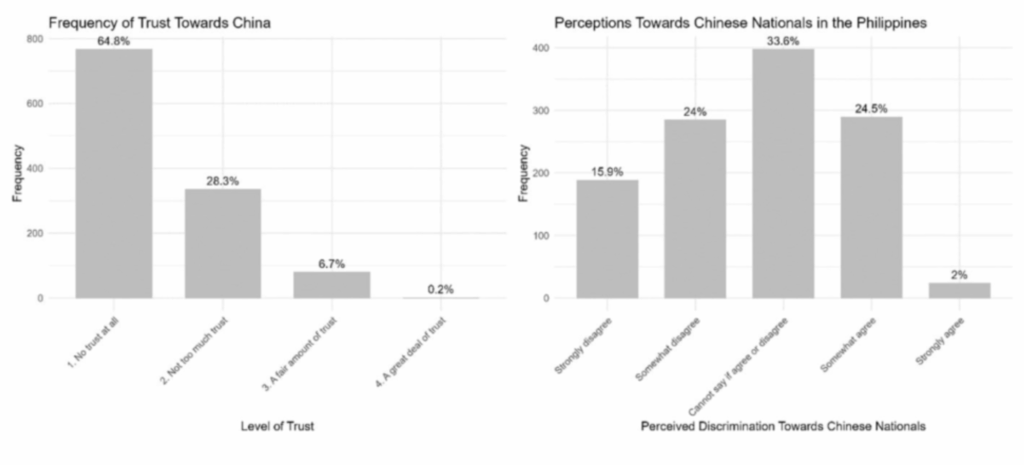
This study looks into how Filipinos feel about China, especially as tensions continue over disputes in the West Philippine Sea. It focuses on two different things: how Filipinos see the Chinese government and how they view Chinese nationals living in the Philippines. While many Filipinos distrust China as a country, they don’t necessarily feel the same hostility toward Chinese Filipinos. The study uses survey data collected by OCTA Research from people all over the country. It finds that where a person lives and the political and social situation in their area can influence their views. The research explains that Filipinos’ negative opinions about China mostly come from national-level issues like territorial conflicts, but their feelings toward Chinese individuals living in the country are shaped more by everyday social and cultural interactions. By studying this, the paper helps us understand how big international problems can affect how ordinary people see foreign countries and the people from those countries who live among them. It also shows why it’s important to consider local experiences and context when looking at public opinion.
This paper is significant because it sheds light on the complex ways Filipinos distinguish between the Chinese government and Chinese nationals living in the Philippines. While tensions over the West Philippine Sea have fueled distrust toward China as a state, the study shows that this does not automatically translate into widespread hostility toward Chinese individuals in the country. By examining this disconnect, the research challenges the common assumption that negative views of a foreign government always lead to prejudice against its people. This distinction is especially important in today’s polarized political climate, where international disputes can easily spill over into social and ethnic tensions.
Furthermore, the study emphasizes the importance of local context in shaping public opinion. It finds that geographical location and local social-political dynamics influence how people view Chinese nationals, suggesting that Filipinos’ attitudes are not monolithic but shaped by their lived experiences. This insight is valuable for both policymakers and scholars, as it highlights the need for more grounded, context-aware approaches when addressing international trust and intergroup relations. Overall, the paper contributes to a more nuanced understanding of how global conflicts intersect with national identity and everyday social interactions, particularly in societies navigating both external pressures and internal diversity.
Authors: Ronald A. Pernia (National College of Public Administration and Governance, University of the Philippines Diliman | National University Philippines, Clark, Pampanga) and Ranjit Singh Rye (Department of Political Science, College of Social Sciences and Philosophy, University of the Philippines Diliman)
Read the full paper: https://link.springer.com/article/10.1007/s41111-025-00294-2