
Researchers develop a UV-protective and self-cleaning fabric coating using environmentally friendly materials and methods
01 Sep 2026
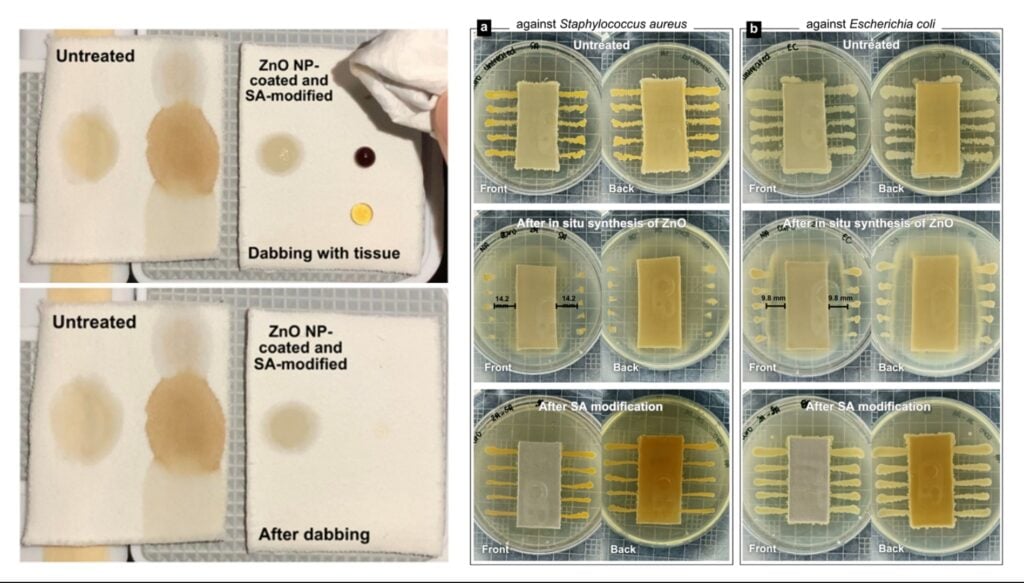
The need for highly protective clothing that requires minimal maintenance is crucial for outdoor workers, especially in the Philippines, where traffic enforcers, street sweepers, construction workers, farmers, and delivery personnel face prolonged exposure to ultraviolet (UV) radiation and encounter potential risks from chemical and biological pollutants. In this study, a self-cleaning and UV-protective coating was developed on cellulose fabric via the green in situ synthesis of zinc oxide nanoparticles (ZnO NPs) and subsequent modification with stearic acid. The self-cleaning effect of the fabric is attributed to its superhydrophobic, water-repellency-induced particulate removal and antibacterial properties. The solution-immersion method was employed to modify the fabric, using zinc (Zn) acetate, Aloe vera leaf skin extract, and stearic acid. XRD and SEM–EDX analyses confirmed the formation of amorphous, irregularly shaped ZnO NPs after the in situ synthesis. This led to excellent UV protection and effective antibacterial activity. Further modification resulted in a superhydrophobic fabric due to the precipitation of stearic acid crystals on the surface. The fabrics exhibited good washing durability and excellent UV protection, even with prolonged sun exposure. Overall, the study demonstrates a viable method for producing a UV-protective and self-cleaning cellulose fabric using environmentally friendly materials and processes.
In the field of nanotechnology, the study holds great significance by exploring alternative synthesis routes for ZnO NPs. More importantly, the application of green synthesis in this study promotes environmentally friendly practices by using non-toxic materials, specifically plant extracts and a fatty acid from natural sources, and by minimizing the use of hazardous chemicals. In addition, the use of the skin of the aloe vera leaves in the synthesis of the nanoparticles not only provides a green alternative but also contributes to waste reduction, making use of what would otherwise be discarded. The findings of the study are also significant in the textile industry, specifically in the fabrication of multifunctional and sustainable textile products. As the method in this study is cost-effective and performed under mild reaction conditions, its potential for large-scale production and commercial application is highly anticipated. Lastly, the multifunctional cotton fabrics from this study can be of great help to outdoor workers who are frequently exposed to occupational hazards due to prolonged sun and pollutant exposure.
Authors: Lorein Angelique P. Caro (Department of Mining, Metallurgical and Materials Engineering, College of Engineering, University of the Philippines Diliman), Mary Donnabelle L. Balela (Department of Mining, Metallurgical and Materials Engineering, College of Engineering, University of the Philippines Diliman), and Ricky Kristan M. Raguindin (Department of Mining, Metallurgical and Materials Engineering, College of Engineering, University of the Philippines Diliman)
Read the full paper: https://doi.org/10.1007/s12221-025-01180-z