Nurses in the Philippines need a supportive work environment, work-life balance, and adequate resources for continuing professional education

17 Sep 2026
As the largest profession that makes up more than half of the country’s health workforce and performs roles as leaders, managers, and collaborators in different settings, especially in areas where there are no physicians, nurses are recognized as being in a critical position to lead the implementation of Universal Health Care (UHC). UHC aims to put “Health in the hands of the Filipino people.” This seeks to give every Filipino access to the full range of quality health services they need, when and where they need them, without financial hardship.

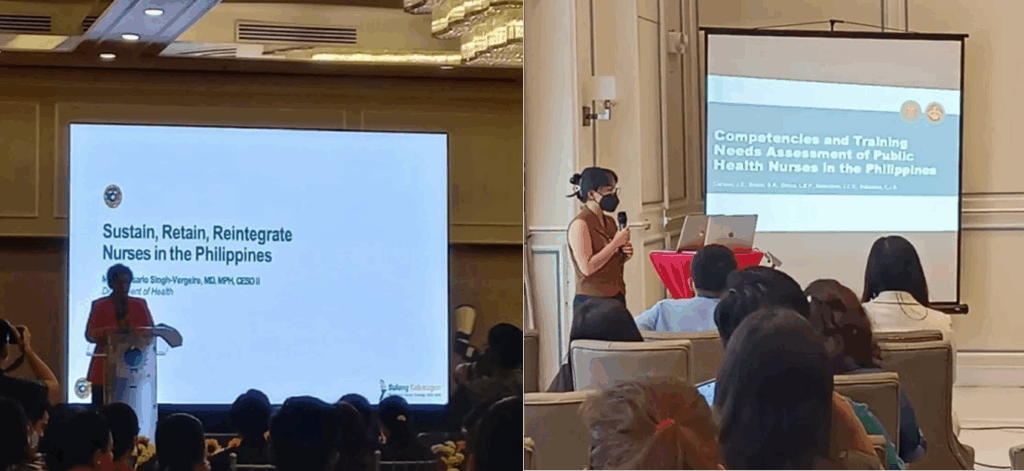
To achieve this, nurses nationwide need to be supported and developed so they can be ready to lead UHC. The results of the study showed that at baseline, public health nurses perceived themselves to be competent (from most to least) in the following: communication, analytical/assessment, community dimensions of practice, policy development/program planning, leadership and systems thinking, cultural competency skills, public health science, and financial planning and management. In terms of training needs, nurses reported the need for a supportive work environment, work-life balance, and adequate technological equipment for continuing professional education. This research also reports the profile of nurses in terms of affiliations, job titles, training, and average time spent on common public health nursing activities. Using these data, key institutions are enabled to make evidence-based and needs-responsive health workforce strengthening programs for public health nurses.

The assessment of perceived competencies and training needs of public health nurses nationwide pushes forward the improvement of healthcare workers’ local working conditions, competencies, and the quality and efficiency of health service delivery. It provides key institutions with data to design and deliver responsive health workforce strengthening.

However, as the country strives to achieve UHC, it faces a triple dilemma in its nursing crisis. First, there is a lack of a unified national nursing database. Second, there are ambiguities in education, employment, and compensation. Third, there are policy gaps and implementation issues in laws for healthcare workers (Hartigan-Go et al., 2024). There is a strong and urgent need to develop, sustain, retain, and reintegrate nurses in the Philippines. The data provided in this research can be useful to set strategic directions toward health workforce strengthening that are oriented to achieve efficient workforce governance, leadership, distribution, retention, and a scaled-up career path for nurses (Dayrit et al., 2018).

Authors: Josephine E. Cariaso, Sheila R. Bonito, Luz Barbara P. Dones, Julia Czen N. Melendres, and Christiane Jannie B. Sebastian (College of Nursing, University of the Philippines Manila)

Read the full paper: https://actamedicaphilippina.upm.edu.ph/index.php/acta/article/view/9301

Image by https://kaboompics.com/ from Pexels

References:
Hartigan-Go, Kenneth and Bongcac, Marianne and Castillo, Angel Faye and Del Rosario, Laura and Eleazar, Ella Mae and Liamzon, Cristina M and Mendoza, Ronald U. and Mina, Enrico and Prieto, Melissa Louise, Navigating the Nursing Exodus: Investigating Philippines’ Bilateral Labor Agreements and its Impact on Nursing Migration (November 12, 2024). Available at SSRN: https://ssrn.com/abstract=5017445 or http://dx.doi.org/10.2139/ssrn.5017445

Dayrit MM, Lagrada LP, Picazo OF, Pons MC, Villaverde MC. The Philippines Health System Review. Vol. 8 No. 2. New Delhi: World Health Organization, Regional Office for South-East Asia; 2018.

Nurses in the Philippines need a supportive work environment, work-life balance, and adequate resources for continuing professional education

As the largest profession that makes up more than half of the country’s health workforce and performs roles as leaders, managers, and collaborators in different settings, especially in areas where there are no physicians, nurses are recognized as being in a critical position to lead the implementation of Universal Health Care (UHC). UHC aims to put “Health in the hands of the Filipino people.” This seeks to give every Filipino access to the full range of quality health services they need, when and where they need them, without financial hardship.

To achieve this, nurses nationwide need to be supported and developed so they can be ready to lead UHC. The results of the study showed that at baseline, public health nurses perceived themselves to be competent (from most to least) in the following: communication, analytical/assessment, community dimensions of practice, policy development/program planning, leadership and systems thinking, cultural competency skills, public health science, and financial planning and management. In terms of training needs, nurses reported the need for a supportive work environment, work-life balance, and adequate technological equipment for continuing professional education. This research also reports the profile of nurses in terms of affiliations, job titles, training, and average time spent on common public health nursing activities. Using these data, key institutions are enabled to make evidence-based and needs-responsive health workforce strengthening programs for public health nurses.

The assessment of perceived competencies and training needs of public health nurses nationwide pushes forward the improvement of healthcare workers’ local working conditions, competencies, and the quality and efficiency of health service delivery. It provides key institutions with data to design and deliver responsive health workforce strengthening.

However, as the country strives to achieve UHC, it faces a triple dilemma in its nursing crisis. First, there is a lack of a unified national nursing database. Second, there are ambiguities in education, employment, and compensation. Third, there are policy gaps and implementation issues in laws for healthcare workers (Hartigan-Go et al., 2024). There is a strong and urgent need to develop, sustain, retain, and reintegrate nurses in the Philippines. The data provided in this research can be useful to set strategic directions toward health workforce strengthening that are oriented to achieve efficient workforce governance, leadership, distribution, retention, and a scaled-up career path for nurses (Dayrit et al., 2018).

Authors: Josephine E. Cariaso, Sheila R. Bonito, Luz Barbara P. Dones, Julia Czen N. Melendres, and Christiane Jannie B. Sebastian (College of Nursing, University of the Philippines Manila)

Read the full paper: https://actamedicaphilippina.upm.edu.ph/index.php/acta/article/view/9301

Image by https://kaboompics.com/ from Pexels

References:
Hartigan-Go, Kenneth and Bongcac, Marianne and Castillo, Angel Faye and Del Rosario, Laura and Eleazar, Ella Mae and Liamzon, Cristina M and Mendoza, Ronald U. and Mina, Enrico and Prieto, Melissa Louise, Navigating the Nursing Exodus: Investigating Philippines’ Bilateral Labor Agreements and its Impact on Nursing Migration (November 12, 2024). Available at SSRN: https://ssrn.com/abstract=5017445 or http://dx.doi.org/10.2139/ssrn.5017445

Dayrit MM, Lagrada LP, Picazo OF, Pons MC, Villaverde MC. The Philippines Health System Review. Vol. 8 No. 2. New Delhi: World Health Organization, Regional Office for South-East Asia; 2018.