
Biodegradable plastic can be successfully extracted from simulated biomass using black soldier fly larvae under normal room conditions
22 Oct 2026
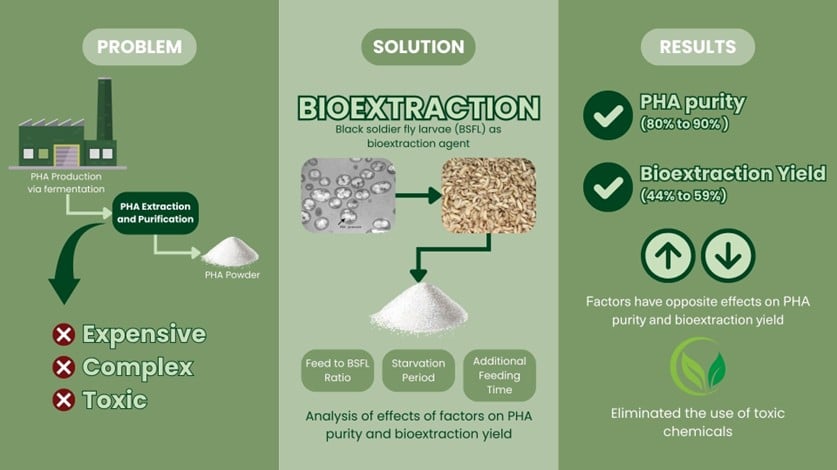
Due to the growing concerns over the use of chlorinated solvents for the extraction of polyhydroxyalkanoate (PHA) after microbial fermentation, there is a pressing need to explore alternative extraction methods. This study investigates the use of black soldier fly larvae (BSFL) as a biological agent for PHA extraction.
The study showed that it is possible to extract P3HB, a type of biodegradable plastic, from simulated biomass using BSFL under normal room conditions. The results also revealed that factors such as the amount of biomass given to the larvae, how long they are starved, and how long they are allowed to feed all affect the efficiency of the extraction and the purity of the plastic.
The analysis found that giving the larvae more biomass and allowing longer feeding times reduced the purity of the plastic, while starving the larvae beforehand improved it. The best conditions for producing the purest plastic were feeding the larvae a small amount of biomass (10% for 48 hours), starving them for 72 hours, and then giving them 24 hours of additional feeding. On the other hand, the highest yield of extracted plastic was achieved by feeding them more biomass (20% for 48 hours), starving them for 24 hours, and then letting them feed for 72 hours.
The parametric analysis revealed an inverse relationship: high PHA purity was associated with low bioextraction yield, and vice versa. Additionally, the feeding factors were found to have opposing effects on PHA purity and bioextraction yield.
Further testing (FTIR analysis) confirmed that the chemical structure of the plastic remained unchanged throughout the process and that proteins were effectively removed. These findings highlight the potential of BSFL as a low-cost, natural method for extracting biodegradable plastics and point to future studies that can optimize the process by considering other factors such as temperature, humidity, and the growth stage of the larvae.
This study is the first to specifically examine the impact of feeding factors on recovered PHA. While the research utilized simulated PHA-containing microbial biomass, further optimization using actual PHA-containing biomass is recommended. Nonetheless, this study provides a valuable foundation for the more efficient application of BSFL-based bioextraction in PHA production downstream processes.
Authors: Alexander Sydney De Leon (Department of Chemical Engineering, College of Engineering and Agro-Industrial Technology, University of the Philippines Los Baños | Biomaterials and Environmental Engineering Laboratory, Department of Engineering Science, College of Engineering and Agro-Industrial Technology, University of the Philippines Los Baños), Jaren U. Tulipan (Biomaterials and Environmental Engineering Laboratory, Department of Engineering Science, College of Engineering and Agro-Industrial Technology, University of the Philippines Los Baños), Myra G. Borines (Department of Chemical Engineering, College of Engineering and Agro-Industrial Technology, University of the Philippines Los Baños), and Jey-R S. Ventura (Biomaterials and Environmental Engineering Laboratory, Department of Engineering Science, College of Engineering and Agro-Industrial Technology, University of the Philippines Los Baños)
Read the full paper: https://doi.org/10.1016/j.biteb.2025.102268