
Child development research draws predominantly from North America, leaving low- to middle-income countries underrepresented
12 Aug 2026
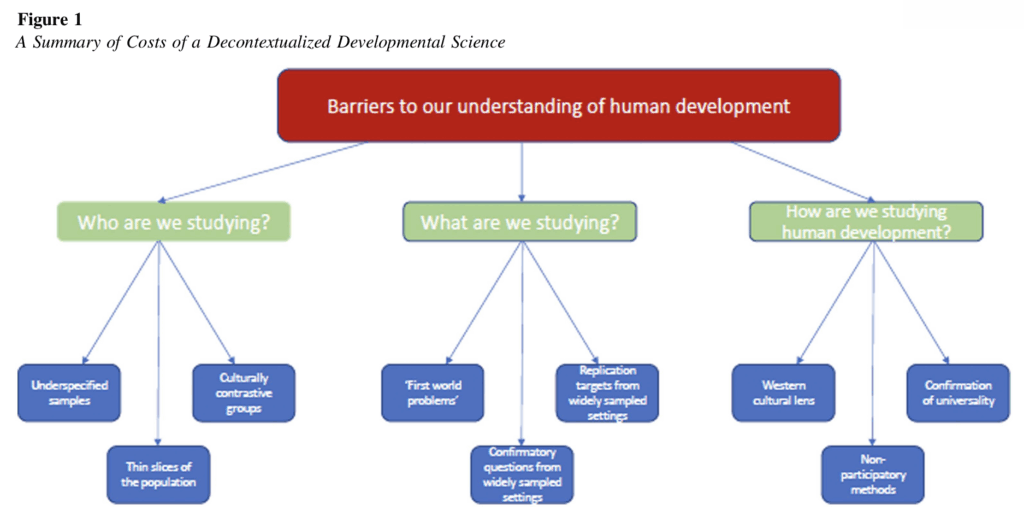
Increasing geographical and cultural diversity in research participation has been a key priority for researchers who are working on child development. In this article, we track changes in participant diversity (e.g., country of origin, socio-economic status) in developmental science over the past decade. These analyses reveal surprisingly modest shifts in global diversity of research participants over time. We found that most participants are from North America, particularly the United States of America, with very few samples coming from low-to-middle-income countries, where most children in the world live. This calls into question the generalizability of our current theories and findings. We provide examples from the study of early child development of the high scientific and ethical costs of a lack of geographical and cultural diversity to demonstrate why greater diversification is essential to a generalizable science of human development. We also discuss strategies for diversification that could be implemented throughout the research ecosystem in the service of a culturally anchored, generalizable, and replicable science.
Contextualist approaches to development situate the study of human development within space and time, acknowledging the enormous variation in human behavior across geographies, lived experiences, and cultures. At the same time, there are indisputable commonalities in human development that transcend space and time. Developmental psychology would benefit from a more careful reconciliation of contextual variation and contextual consistency, recognizing that all humans share some developmental capacities but that meaningful variation also exists (Singh, D’Souza, & Frank, 2024). Understanding where this meaningful variation resides is critical to our knowledge of reported effects and their boundary conditions (Doebel & Frank, 2024; Legare, 2017).
In this study, we examined how representative our current evidential base is of the world’s geographies, lived experiences, and cultures. Crucially, we found only a modest increase in the diversity of our evidential base over the past decade. We provide examples from the study of early child development of the high scientific and ethical costs of a lack of geographical and cultural diversity to demonstrate why greater diversification is essential to a generalizable science of human development. More importantly, we discuss strategies for diversification that could be implemented throughout the research ecosystem. We hope that different stakeholders can use these strategies to achieve a culturally anchored, generalizable, and replicable science.
Authors: Leher Singh (epartment of Psychology, University of Maryland), Dana Basnight-Brown (Department of Psychology, United States International University), Bobby K. Cheon (Division of Population Health Research, Eunice Kennedy Shriver National Institute of Child Health and Human Development), Rowena Garcia (Department of Linguistics, Developmental Psycholinguistics Group, University of Potsdam | Department of Language Development, Max Planck Institute for Psycholinguistics | Department of Speech Pathology, University of the Philippines Manila), Melanie Killen (Department of Human Development and Quantitative Methodology, University of Maryland), and Reiko Mazuka (RIKEN Center for Brain Science, Saitama, Japan | Research Institute for Science and Engineering, Waseda University | Department of Psychology and Neuroscience, Duke University)
Read the full paper: https://dx.doi.org/10.1037/dev0001841