
Even without curvature, forces can still exist between particles
27 Oct 2026
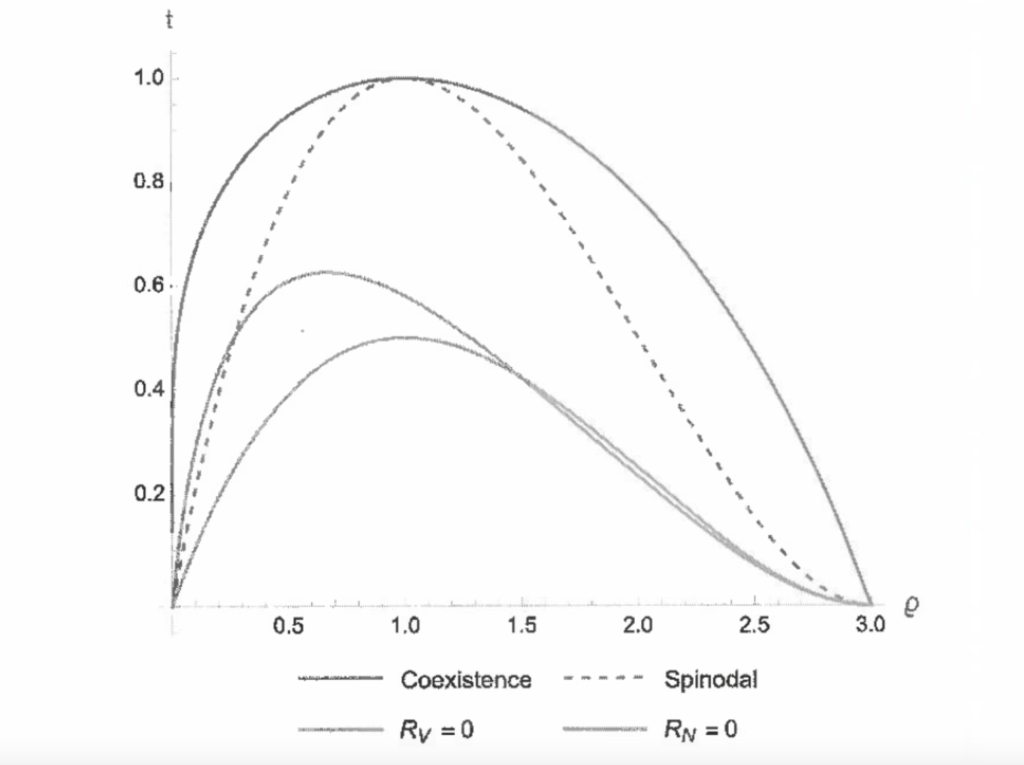
Our work is concerned with thermodynamic geometry, which is a branch of physics that studies the “shapes” of thermodynamic systems—such as gases and fluids—in an abstract, mathematical sense. This concept of shape doesn’t refer to physical form, but rather to a geometric structure that describes how the system behaves.
We use a particular approach proposed by physicist George Ruppeiner, who suggested that the curvature of this abstract geometry reveals information about how particles in a system interact. According to this view, if the curvature is nonzero, it indicates that particles are interacting—say, repelling or attracting each other. If the curvature is exactly zero, the system is thought to consist of non-interacting particles.
In this work, we challenge that interpretation. By constructing examples of systems with zero curvature that still exhibit interactions, we show that zero curvature does not necessarily mean a lack of interaction. In other words, the absence of curvature does not guarantee the absence of forces between particles.
While we focus on gases in this paper, we believe these insights may extend to more exotic systems, such as black holes, where the nature of interactions is still not fully understood.
This work furthers the study of the relationship between interparticle interactions and thermodynamic curvature. Our findings extend upon a theme in previous work, also published in Physical Review E [K. de Leon and I. Vega, Phys. Rev. E 106, 054141 (2022)], where one of us found that a less-studied variant of the Ruppeiner metric (termed the Ruppeiner-N metric in that work) appears to be more appropriate for the study of phase transitions. Further study of the Ruppeiner-N metric was left for future work.
Authors: Juan Rodrigo and Ian Vega (National Institute of Physics, University of the Philippines Diliman)
Read the full paper: http://journals.aps.org/pre/abstract/10.1103/PhysRevE.111.054120