
Evidence shows that during the Pleistocene, Luzon—long thought to lack native large mammalian carnivores—was home to a sizeable predator
13 Nov 2025
Fossils are preserved remains or traces of ancient organisms, often turned to rock. Body fossils include parts like shells, teeth, or bones, while trace fossils (ichnofossils), such as footprints or burrows, reveal how ancient creatures lived and behaved. Trace fossils can even hint at the presence of animals we haven’t discovered yet through their bones or teeth.
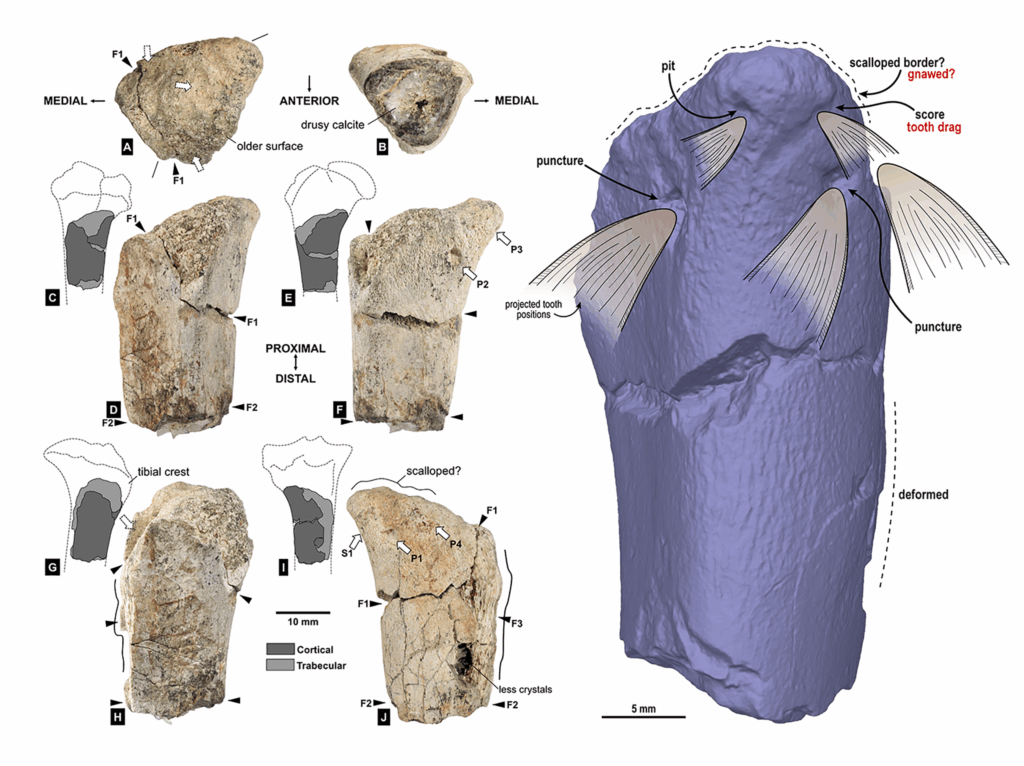
We examined bite marks on a fossilized deer (Rusa sp.) shinbone (tibia) we discovered from a Pleistocene (2.6 million–11,000 years ago) river channel in northwestern La Union (Bacnotan-Balaoan), Luzon, Philippines. Other fossils found include bones and teeth of the Luzon tamaraw (Bubalus sp.), a wild boar tusk (Sus sp.), and a crocodile tooth.
Our analysis suggests a large carnivore made the bite marks. While consistent with crocodile feeding, some gnawing-like marks point to a mammalian carnivore, such as a big cat or wild dog. This possibility is fascinating, given the lack of body fossils or extant native species of these predators on Luzon Island.
Unlike Luzon, which has always been isolated, Palawan has yielded tiger fossils and may have been connected to Borneo and Sundaland during periods of low sea levels. Smaller carnivores like civets and leopard cats are likely more recent arrivals or were introduced by humans.
This study underscores how much we still have to learn about the prehistoric biodiversity of Luzon and the Philippines, knowledge that is increasingly important in light of modern biodiversity and climate crises. It shows the potential for further discoveries given the underexplored fossil record of Luzon and the Philippines, which can contribute to understanding the prehistoric biodiversity of the region and the broader dynamics of insular evolution and biogeography. This study also highlights the utility of examining trace fossils to infer other faunal members that body fossils may not represent.
Authors: Meyrick U. Tablizoa (Nannoworks Laboratory, National Institute of Geological Sciences, College of Science, University of the Philippines Diliman), Rebekka Volmer (Ateneo de Manila University, Department of Sociology and Anthropology, Quezon City | Senckenberg Forschungsinstitut und Naturmuseum Frankfurt, “The Role of Culture in Early Expansions of Humans” (ROCEEH)), Allan Gil S. Fernando (Nannoworks Laboratory, National Institute of Geological Sciences, College of Science, University of the Philippines Diliman), and Juan C. Rofes (School of Archaeology, University of the Philippines Diliman | Archéozoologie, Archéobotanique : Sociétés, Pratiques et Environnements (AASPE, UMR 7209), CNRS/MNHN | National Museum of the Philippines)
Read the full paper: https://www.sciencedirect.com/science/article/pii/S0753396923000642?via%3Dihub