
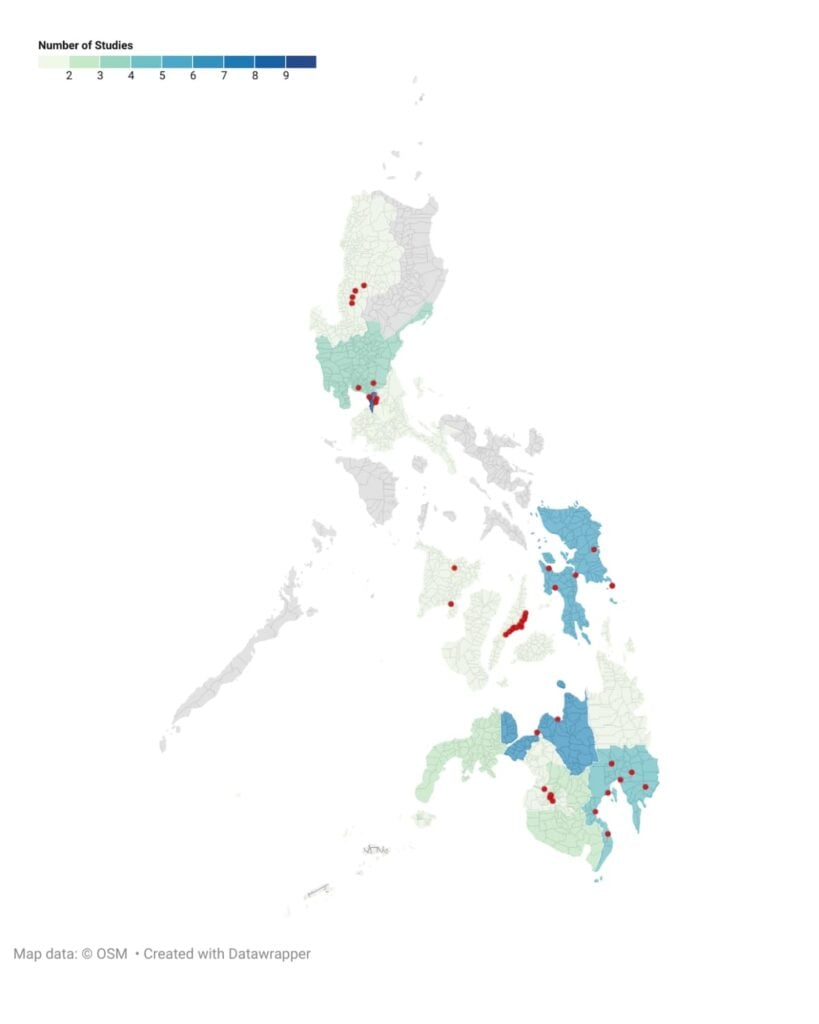
Research on climate change and health in the Philippines focuses mostly on Luzon, with very few studies utilizing long-term data
14 Aug 2026
Climate change affects health worldwide, but its impacts are often greater in vulnerable countries like the Philippines.
In 2024, the Philippines registered the highest disaster risk in the world, with significant exposure to different intensity levels of earthquakes, tsunamis, cyclones, coastal and riverine flooding, droughts, and sea-level rise. Its susceptibility to these disasters, lack of coping capacities, and lack of adaptive capacities jointly elevate such risk (Frege et al., 2024).
In this paper, we wanted to understand how research on climate change and health in the Philippines has evolved in recent years. This review looked at studies published from 2018 to 2023 and compared them to an earlier coping review.
We searched thousands of scientific articles and found 69 studies that met our criteria. These studies were grouped into six main topics: diseases and injuries linked to climate, direct effects of weather (like heatwaves and storms), effects on ecosystems that influence health, impacts through human systems such as healthcare and infrastructure, adaptation strategies to cope with climate risks, and health benefits that can come from climate change mitigation.
Compared to the previous scoping review (1980–2017), there has been a clear rise in research, especially in areas like mental health, gender-specific vulnerabilities, and adaptation measures. However, most studies were focused in Luzon, meaning other regions like Visayas and Mindanao are underrepresented. Very few studies used long-term data, and research on the added health benefits of climate change solutions remains scarce.
Our findings show that progress has been made, but important gaps remain. More research is needed in other parts of the country, with better long-term monitoring and analysis, to guide policies and ensure climate and health actions are equitable and effective.
Authors: Clarissa De Guzman (Institute of Child Health and Human Development, National Institutes of Health, University of the Philippines Manila), Megan Lorenza Cabaero (Institute of Child Health and Human Development, National Institutes of Health, University of the Philippines Manila), Jude Raphael Lo (Institute of Child Health and Human Development, National Institutes of Health, University of the Philippines Manila), Jimmy Loro (Deutsche Gesellschaft für Internationale Zusammenarbeit, Makati, Philippines), Maria Vinna Crisostomo (Institute of Child Health and Human Development, National Institutes of Health, University of the Philippines Manila), Michelle Ylade (Institute of Child Health and Human Development, National Institutes of Health, University of the Philippines Manila) and Kristal An Agrupis (Institute of Child Health and Human Development, National Institutes of Health, University of the Philippines Manila)
Read the full paper: https://doi.org/10.3389/fclim.2025.1594793