
Advanced machine learning models now enable reliable prediction of maximum temperatures in Manila and Dagupan City

30 Dec 2025
UP Diliman, UP Los Baños

The extreme rise in temperature and accelerating climate change present significant challenges to sustainability, particularly in urban areas. Climate change is making cities in the Philippines hotter, creating a need for better ways to manage and adapt to rising temperatures.

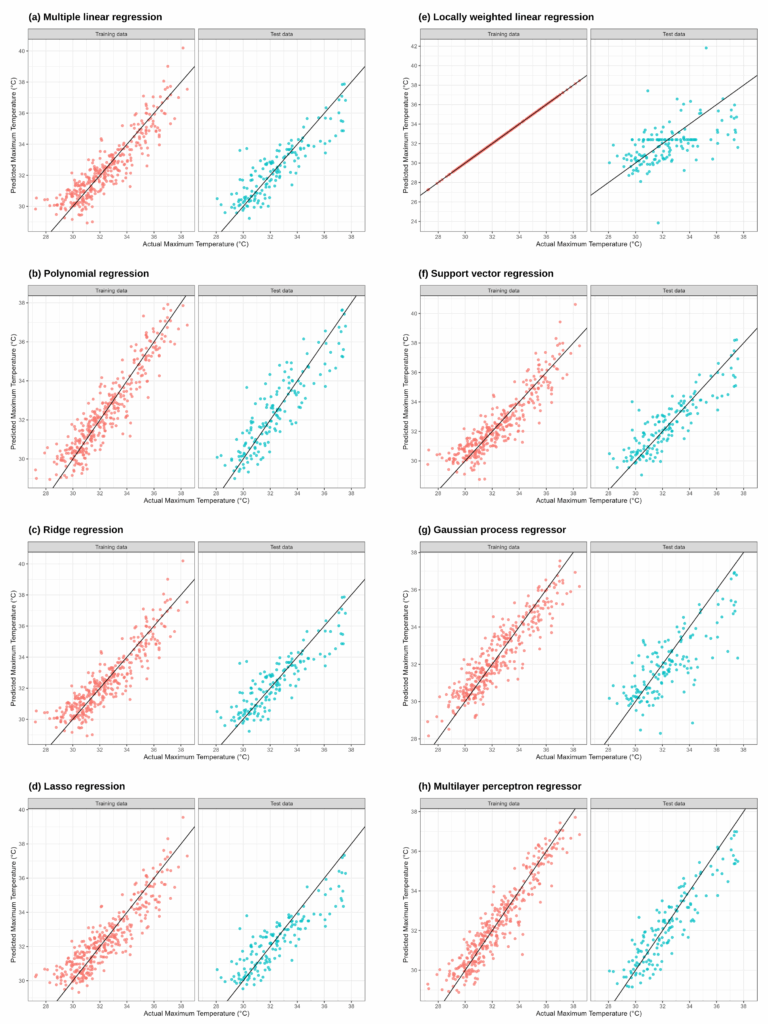
To support ongoing efforts to create sustainable communities and enhance climate change mitigation and adaptation strategies in the Philippines, we developed machine learning models to predict maximum temperatures (measured two meters above ground) in Manila and Dagupan City. We used weather and environmental data, applying techniques like scaling, pattern analysis, and advanced ML models. Among the tested models, the multilayer perceptron (MLP) performed best for Manila, accurately predicting temperatures. Another model, Long Short-Term Memory (LSTM), showed decent results when focusing on past temperature trends. These models serve as a valuable tool for informed decision-making. It could also serve as a benchmark for future studies in this country. However, the study found that models trained on Manila’s data did not work well for Dagupan, highlighting the need for location-specific approaches.

Our findings highlight the importance of addressing sustainability challenges through educated, evidence-based research on climate change, particularly in shaping policies and guiding decision-making. In this context, we believe that leveraging machine learning for temperature forecasting can provide new, data-driven insights. Our multi-step-ahead forecasting approach offers a powerful means of anticipating urban heating, equipping local authorities with timely information for proactive measures. With more accurate forecasts of maximum temperature, policymakers can make more informed decisions toward a more sustainable living in Philippine cities.

Authors: Jamlech Iram Gojo Cruz (Artificial Intelligence Program, University of the Philippines Diliman | Institute of Computer Science, University of the Philippines Los Baños), Jose Maria Lorenzo de Vera (Artificial Intelligence Program, University of the Philippines Diliman) and Karl Ezra Pilario (Artificial Intelligence Program, University of the Philippines Diliman | Process Systems Engineering Laboratory, Department of Chemical Engineering, University of the Philippines Diliman)

Read the full paper: https://doi.org/10.1016/j.uclim.2025.102339

Advanced machine learning models now enable reliable prediction of maximum temperatures in Manila and Dagupan City

The extreme rise in temperature and accelerating climate change present significant challenges to sustainability, particularly in urban areas. Climate change is making cities in the Philippines hotter, creating a need for better ways to manage and adapt to rising temperatures.

To support ongoing efforts to create sustainable communities and enhance climate change mitigation and adaptation strategies in the Philippines, we developed machine learning models to predict maximum temperatures (measured two meters above ground) in Manila and Dagupan City. We used weather and environmental data, applying techniques like scaling, pattern analysis, and advanced ML models. Among the tested models, the multilayer perceptron (MLP) performed best for Manila, accurately predicting temperatures. Another model, Long Short-Term Memory (LSTM), showed decent results when focusing on past temperature trends. These models serve as a valuable tool for informed decision-making. It could also serve as a benchmark for future studies in this country. However, the study found that models trained on Manila’s data did not work well for Dagupan, highlighting the need for location-specific approaches.

Our findings highlight the importance of addressing sustainability challenges through educated, evidence-based research on climate change, particularly in shaping policies and guiding decision-making. In this context, we believe that leveraging machine learning for temperature forecasting can provide new, data-driven insights. Our multi-step-ahead forecasting approach offers a powerful means of anticipating urban heating, equipping local authorities with timely information for proactive measures. With more accurate forecasts of maximum temperature, policymakers can make more informed decisions toward a more sustainable living in Philippine cities.

Authors: Jamlech Iram Gojo Cruz (Artificial Intelligence Program, University of the Philippines Diliman | Institute of Computer Science, University of the Philippines Los Baños), Jose Maria Lorenzo de Vera (Artificial Intelligence Program, University of the Philippines Diliman) and Karl Ezra Pilario (Artificial Intelligence Program, University of the Philippines Diliman | Process Systems Engineering Laboratory, Department of Chemical Engineering, University of the Philippines Diliman)

Read the full paper: https://doi.org/10.1016/j.uclim.2025.102339