
Remote sites benefit the most from primary care interventions with the highest increase in outpatient consultations and the largest decrease in out-of-pocket expenses
29 Dec 2025
Unequal access to health services remains a major problem in the Philippines. Social, economic, and geographic barriers limit people’s access to quality healthcare, leading to uneven health outcomes across regions and income groups. Although policies such as the National Health Insurance Act of 2013 aimed to expand health coverage, many barriers persist. High out-of-pocket costs and limited availability of quality services continue to discourage healthcare use, especially in resource-poor and geographically isolated and disadvantaged areas.
To address these gaps, the government passed the Universal Health Care (UHC) Law in 2018 to strengthen primary care nationwide. In support of this law, the Philippine Primary Care Studies (PPCS) program piloted primary care interventions in urban, rural, and remote areas. These pilot projects aim to identify practical and effective strategies for achieving universal health coverage and to show policymakers how to invest in primary care systems that are feasible, efficient, effective, and equitable.
This study aimed to determine the effects of primary care interventions on healthcare utilisation and estimated out-of-pocket (OOP) expenses in selected urban, rural, and remote settings in the Philippines. Context-specific measures relating to expanding healthcare provider networks, augmenting the health human workforce, and subsidising transportation costs were implemented to strengthen primary care systems.
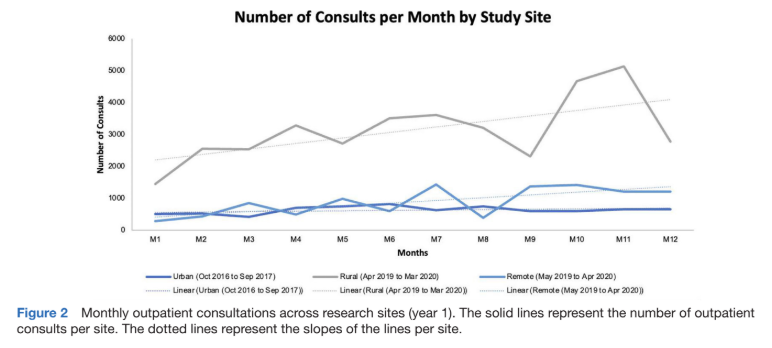
All sites had a positive trend in monthly outpatient consultations in healthcare utilisation over one year. The remote site had the steepest increase in outpatient consultations, with a 401% increase compared with the baseline during the peak of consultations at month 7. The urban site had a 62% increase in outpatient consultations from baseline to month 6, while the rural site had a 251% increase from baseline to month 11, which corresponded to the peak month in terms of the number of outpatient consultations.
The rural site had the largest decrease in estimated OOP expenses (50.3% reduction, 95% CI −88 to –13), followed by the remote site (33.2% reduction, 95% CI −67,+1) and the urban site (16.0% reduction, 95% CI− 65,+33). The rural site showed a significant reduction in estimated OOP expenses and an increase in healthcare utilisation. The remote site had the steepest increase in utilisation, but the reduction in estimated OOP expenses was not statistically significant. The urban site experienced the lowest increase in utilisation, and the smallest reduction in estimated OOP expenses, which was also not statistically significant. Implementing primary care benefits will necessitate contextualised approaches to avoid inadvertent aggravation of inequities in healthcare.
Authors: Janelle Micaela S Panganiban (Program on Health Systems Development – Philippine Primary Care Studies, Center for Integrative and Development Studies, University of the Philippines Diliman), Romelei Camiling-Alfonso (Program on Health Systems Development – Philippine Primary Care Studies, Center for Integrative and Development Studies, University of the Philippines Diliman), Josephine T Sanchez (Program on Health Systems Development – Philippine Primary Care Studies, Center for Integrative and Development Studies, University of the Philippines Diliman), Regine Ynez H De Mesa (Program on Health Systems Development – Philippine Primary Care Studies, Center for Integrative and Development Studies, University of the Philippines Diliman), Gillian Sandigan (Program on Health Systems Development – Philippine Primary Care Studies, Center for Integrative and Development Studies, University of the Philippines Diliman), Arianna Maever L Amit (National Clinical Trials and Translation Center, National Institutes of Health, University of the Philippines Manila | Center for Research and Innovation, School of Medicine and Public Health, Ateneo de Manila University), Mia P Rey (Program on Health Systems Development – Philippine Primary Care Studies, Center for Integrative and Development Studies, University of the Philippines Diliman | Department of Accounting and Finance, Cesar E A Virata School of Business, University of the Philippines Diliman), Johanna Faye E Lopez (Program on Health Systems Development – Philippine Primary Care Studies, Center for Integrative and Development Studies, University of the Philippines Diliman), Noleen Marie Fabian (Program on Health Systems Development – Philippine Primary Care Studies, Center for Integrative and Development Studies, University of the Philippines Diliman | University of the East Ramon Magsaysay Memorial Medical Center Inc.), Cara Lois T Galingana (Program on Health Systems Development – Philippine Primary Care Studies, Center for Integrative and Development Studies, University of the Philippines Diliman), Nannette Bernal-Sundiang (Program on Health Systems Development – Philippine Primary Care Studies, Center for Integrative and Development Studies, University of the Philippines Diliman), Maria Rhodora N Aquino (Program on Health Systems Development – Philippine Primary Care Studies, Center for Integrative and Development Studies, University of the Philippines Diliman), Chad Lester Lastrilla (Program on Health Systems Development – Philippine Primary Care Studies, Center for Integrative and Development Studies, University of the Philippines Diliman), Miguel Callo (Program on Health Systems Development – Philippine Primary Care Studies, Center for Integrative and Development Studies, University of the Philippines Diliman), Carol Stephanie Chua Tan-Lim (Program on Health Systems Development – Philippine Primary Care Studies, Center for Integrative and Development Studies, University of the Philippines Diliman | Department of Clinical Epidemiology, College of Medicine, University of the Philippines Manila), Leonila F Dans (Program on Health Systems Development – Philippine Primary Care Studies, Center for Integrative and Development Studies, University of the Philippines Diliman), Jose Rafael A Marfori (Program on Health Systems Development – Philippine Primary Care Studies, Center for Integrative and Development Studies, University of the Philippines Diliman | Department of Clinical Epidemiology, College of Medicine, University of the Philippines Manila), Ramon Pedro Paterno (Program on Health Systems Development – Philippine Primary Care Studies, Center for Integrative and Development Studies, University of the Philippines Diliman), and Antonio L Dans (Program on Health Systems Development – Philippine Primary Care Studies, Center for Integrative and Development Studies, University of the Philippines Diliman | College of Medicine, University of the Philippines Manila)
Read the full paper: https://bmjopenquality.bmj.com/content/14/1/e002676