
A simple artificial intelligence method makes it possible to digitally restore severely degraded historical architectural drawings
03 Feb 2026
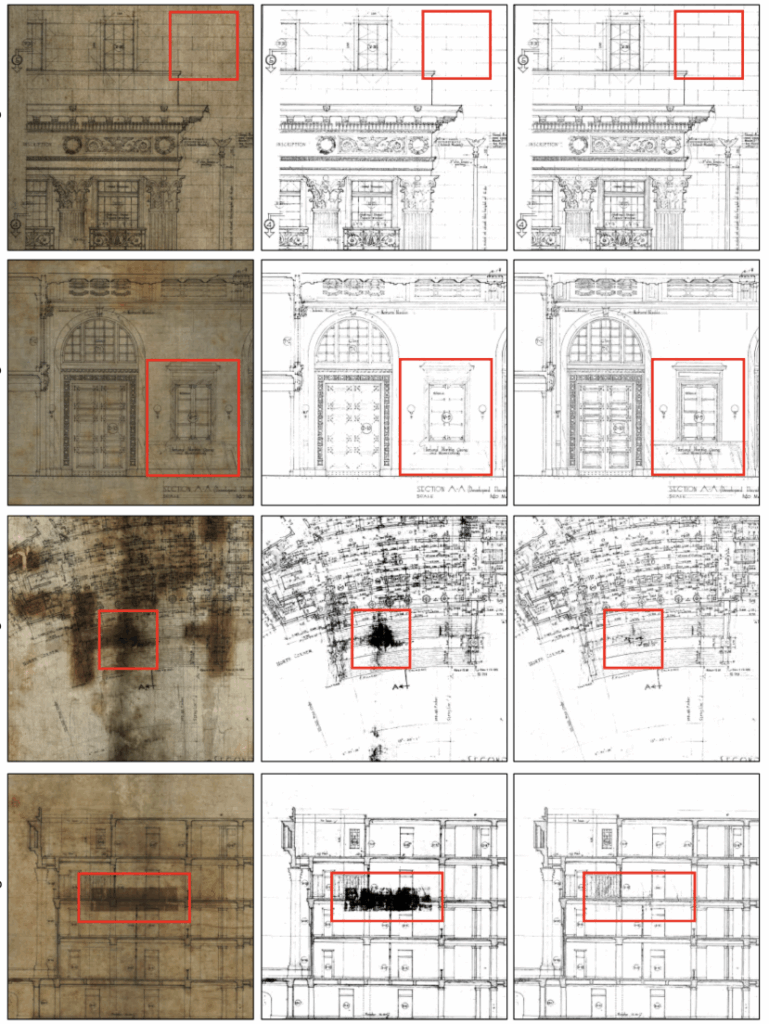
Historical architectural drawings are important records of our cultural heritage, but many have been damaged or degraded over time. For architects and engineers, digitizing these documents and converting them into vector format is crucial. However, severe stains—sometimes as dark as the original lines—often obscure intricate details, making the process challenging. The 1938 architectural drawings of the Department of Agriculture and Commerce Building in Manila (now the National Museum of Natural History), for example, have severe stains that make them difficult to appreciate and restore. Traditional methods of cleaning these images often fail because the stains are too dark, making it hard to separate the original lines from the stains.
To address this, we developed a specialized artificial intelligence (AI) model that can digitally clean these drawings. Our approach uses a type of AI called a shallow convolutional autoencoder, which learns to identify and remove stains while keeping the original lines intact. Unlike other AI models that require expensive, high-powered computers, our method is simple yet effective, making it accessible for museums, researchers, and conservators with limited technical resources but who need reliable tools for document restoration.
We tested our model on 26 historical drawings and found that it successfully restored the images. Our model successfully separated the stains from the drawn lines, enabling the digital restoration of these heavily degraded documents and significantly enhancing their readability. Even better, our method worked on another collection of architectural drawings of a different material, size, and level of damage. This means that our approach can be adapted to restore many types of historical documents worldwide. By making digital restoration easier and more affordable, we provided a replicable workflow that helps preserve important cultural artifacts for future generations while providing a practical tool for historians, architects, and conservationists.
Authors: Mark Jeremy G. Narag (National Institute of Physics, College of Science, University of the Philippines Diliman), Gerard Rey Lico (College of Architecture, University of the Philippines Diliman) and Maricor Soriano (National Institute of Physics, College of Science, University of the Philippines Diliman)
Read the full paper: https://doi.org/10.1016/j.engappai.2025.110400