
Study examines the technical and economic potential of floating offshore wind energy in the Philippines
04 Sep 2026
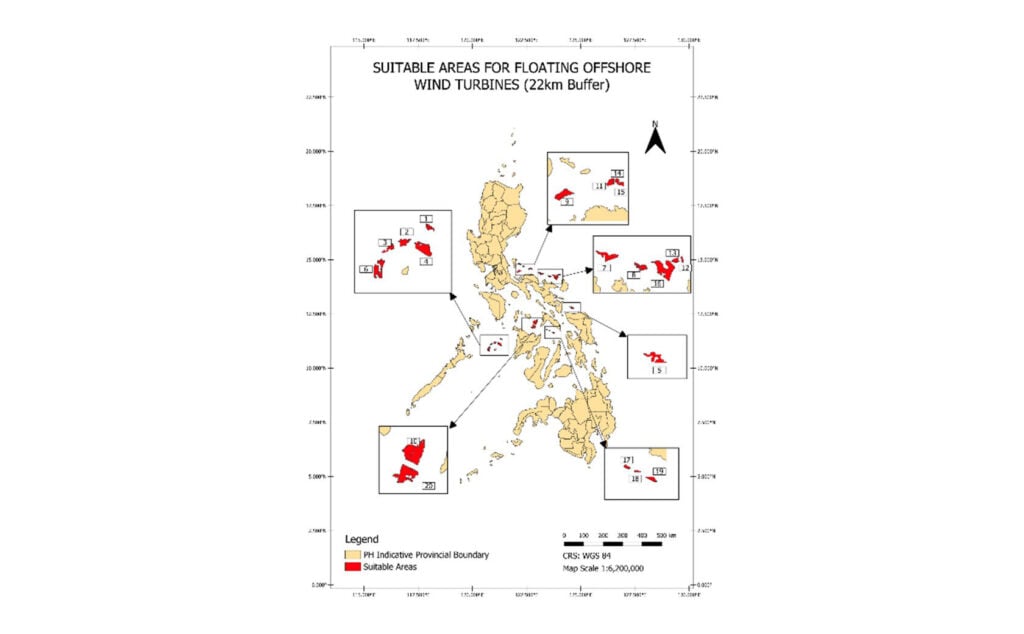
Offshore wind development in the Philippines remains at a standstill owing to the relatively high cost of the technology despite the government’s ambitious goal to produce 19–50 GW of renewable energy from offshore wind by 2050.
The recent World Bank study has shown that there is 178GW of potential for the Philippines. However, the methodology behind the study remains to be verified. It has since been shown that the distinction in the World Bank study between floating and bottom-fixed turbines is distance to shore – this is inaccurate since the technical distinction between the two types is based on depth, wherein floating turbines are used for depths greater than 50m. The bathymetry of the Philippines has depths greater than 50m within the set distance threshold of the World Bank study. Thus, the paper corrects the potential calculations, as well as identifies sites that can be specifically exploited only by floating offshore wind turbines.
Previous studies have shown that bottom-fixed turbines can be utilized to reach the lower end of the production target. Still, most potential can be achieved at greater depths, where floating turbines are more appropriate. Therefore, this study performs a techno-economic assessment of floating offshore wind energy using the Global Information System (GIS) software to analyze the technical and economic potential of floating offshore wind energy in the Philippines.
Data from the Global Wind Atlas was used to obtain the technical potential of sites that may be used for floating offshore wind turbines. Exclusion zones are set up according to distance from shore, marine protected areas, oil and petroleum sites, shipping lanes, and submarine cables. Factors related to distance to shore, port, and substation, as well as natural hazards and bathymetry, are considered using a weighted analytic hierarchy process. The net present value (NPV) of each potential site is then calculated by considering the capital, operational, and decommissioning costs of a site at a 6% interest rate and 25 years of operational life. Results show that a total potential of 813 GW can be produced from 20 non-contiguous sites. However, the current feed-in tariff (FIT) rate of 8.53 Php/kW is insufficient to make any sites profitable, as all NPVs are negative. The break-even prices can guide the Philippine government in setting an appropriate rate at a minimum of 10.14 Php/kW.
This study can be used in conjunction with the paper of Maandal et al. tackling bottom-fixed turbines to complete the techno-economic assessment of offshore wind turbines in the Philippines and help industry and government implement better and more accurate strategies to achieve the 19-50GW offshore renewable wind energy target for 2050.
Authors: Alec Venzo Abella, John Michael Pasaraba, and Job Immanuel Encarnacion (Department of Mechanical Engineering, University of the Philippines Diliman)
Read the full paper: https://doi.org/10.26748/KSOE.2024.085