
Food insecurity is linked to poor sleep among older adults

25 Nov 2026
Getting enough good sleep is important for staying healthy, but many older adults struggle with sleep problems. At the same time, not having enough food or worrying about where the next meal will come from can harm both mental and physical health. There have been studies linking food insecurity to sleep problems in the adult population. However, investigation into this relationship among the older adult population living in low- and middle-income countries is scarce. Moreover, existing studies are limited in explaining the underlying mechanisms between food insecurity and sleep deficiency.

To address these gaps, we used the baseline data from the Longitudinal Study of Ageing and Health
in the Philippines (LSAHP), a study with a nationally representative sample of older Filipinos, to examine the relationship between food insecurity and sleep deficiency among community-dwelling older adults in the Philippines. Using an existing framework, we also investigated the psychological and biobehavioral mechanisms between food insecurity and sleep problems among community-dwelling older adults.

Our research explored how food insecurity affects sleep among older adults in the Philippines. We studied nearly 3,600 people aged 60 and older from across the country. We found that the prevalence of food insecurity was 13% among community-dwelling older Filipinos and the prevalence of sleep deficiency was 80%. We found that food insecurity was linked to poor sleep, but mainly because it increased the chances of depression and physical weakness (frailty). In other words, it is not just the lack of food itself that disrupts sleep, but the way it affects people’s mental health and physical strength.

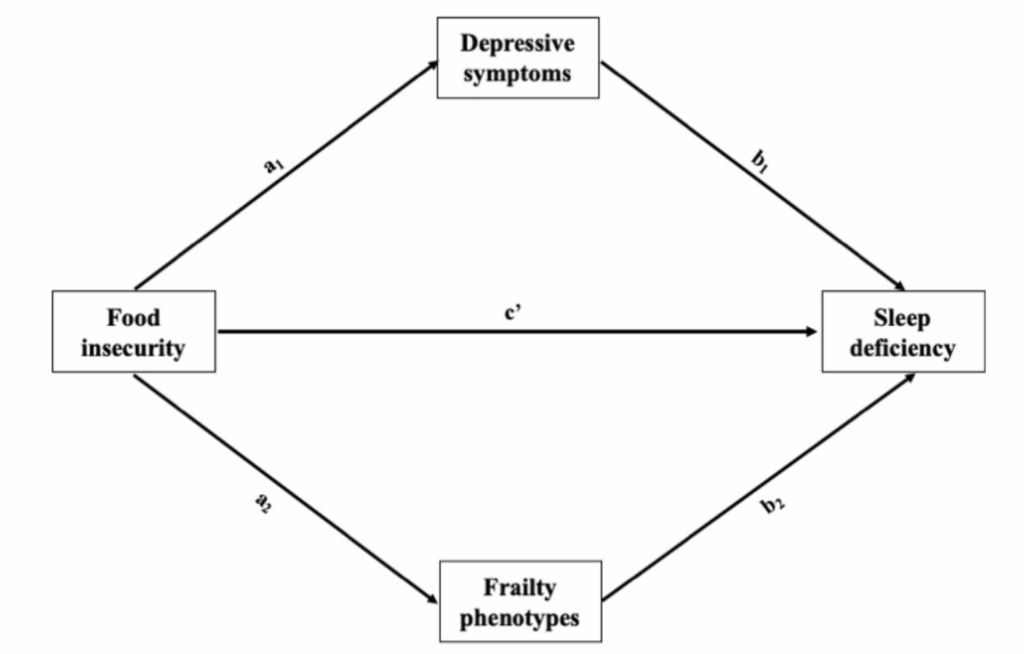
Our results showed that depressive symptoms and frailty phenotypes among community-dwelling older Filipinos were two plausible explanations for the experiences of sleep deficiency when suffering from food insecurity. Older adults who are food insecure at baseline experience sleep deficiency because of increased depressive symptoms and pronounced frailty phenotypes.

These findings suggest that tackling depression and frailty may help improve sleep among older adults who experience food insecurity. Supporting mental health, preventing frailty, and ensuring food security could therefore play a big role in helping older people live healthier and more restful lives.

Authors: Divine Grace C. Domingo (Department of Global Health and Health Security, Taipei Medical University | Institute of Human Nutrition and Food, University of the Philippines Los Baños), Tuo-Yu Chen (Institute of European and American Studies, Academia Sinica), Grace Cruz (Population Institute, University of the Philippines Diliman), Philile S. Mgabhi (Department of Global Health and Health Security, Taipei Medical University), Kian Lee Lim (Department of Global Health and Health Security, Taipei Medical University), Chrispin Mandiwa (Department of Global Health and Health Security, Taipei Medical University), and Yasuhiko Saito (College of Economics, Nihon University | Economic Research Institute for ASEAN and East Asia, Jakarta)

Read the full paper: https://jogh.org/2025/jogh-15-04235

Image by Domingo, et al.

Food insecurity is linked to poor sleep among older adults

Getting enough good sleep is important for staying healthy, but many older adults struggle with sleep problems. At the same time, not having enough food or worrying about where the next meal will come from can harm both mental and physical health. There have been studies linking food insecurity to sleep problems in the adult population. However, investigation into this relationship among the older adult population living in low- and middle-income countries is scarce. Moreover, existing studies are limited in explaining the underlying mechanisms between food insecurity and sleep deficiency.

To address these gaps, we used the baseline data from the Longitudinal Study of Ageing and Health
in the Philippines (LSAHP), a study with a nationally representative sample of older Filipinos, to examine the relationship between food insecurity and sleep deficiency among community-dwelling older adults in the Philippines. Using an existing framework, we also investigated the psychological and biobehavioral mechanisms between food insecurity and sleep problems among community-dwelling older adults.

Our research explored how food insecurity affects sleep among older adults in the Philippines. We studied nearly 3,600 people aged 60 and older from across the country. We found that the prevalence of food insecurity was 13% among community-dwelling older Filipinos and the prevalence of sleep deficiency was 80%. We found that food insecurity was linked to poor sleep, but mainly because it increased the chances of depression and physical weakness (frailty). In other words, it is not just the lack of food itself that disrupts sleep, but the way it affects people’s mental health and physical strength.

Our results showed that depressive symptoms and frailty phenotypes among community-dwelling older Filipinos were two plausible explanations for the experiences of sleep deficiency when suffering from food insecurity. Older adults who are food insecure at baseline experience sleep deficiency because of increased depressive symptoms and pronounced frailty phenotypes.

These findings suggest that tackling depression and frailty may help improve sleep among older adults who experience food insecurity. Supporting mental health, preventing frailty, and ensuring food security could therefore play a big role in helping older people live healthier and more restful lives.

Authors: Divine Grace C. Domingo (Department of Global Health and Health Security, Taipei Medical University | Institute of Human Nutrition and Food, University of the Philippines Los Baños), Tuo-Yu Chen (Institute of European and American Studies, Academia Sinica), Grace Cruz (Population Institute, University of the Philippines Diliman), Philile S. Mgabhi (Department of Global Health and Health Security, Taipei Medical University), Kian Lee Lim (Department of Global Health and Health Security, Taipei Medical University), Chrispin Mandiwa (Department of Global Health and Health Security, Taipei Medical University), and Yasuhiko Saito (College of Economics, Nihon University | Economic Research Institute for ASEAN and East Asia, Jakarta)

Read the full paper: https://jogh.org/2025/jogh-15-04235

Image by Domingo, et al.