
Measuring the Goos-Hänchen shift distinguishes silicon from gallium arsenide

25 Jun 2026
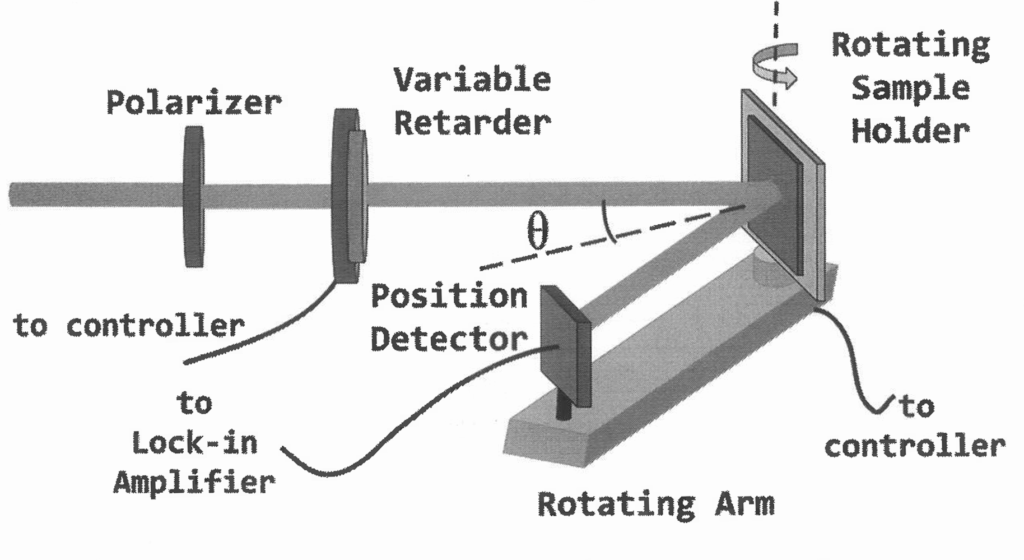
An immediate analogy for our study can be found in a familiar sight: a straw in a glass of water that looks bent. That’s because light changes direction when it hits a new material.

Even though it is not a one-to-one correspondence, when a light beam reflects off a surface, the position of the reflected light can deviate from its expected path and position, a subtle effect called the Goos-Hänchen shift.

Our research focused on measuring this small shift in two well-known materials: silicon and gallium arsenide. These materials are important in electronics and optics, but they can be tricky to tell apart if the detecting devices are not sensitive enough because they behave very similarly.

We discovered that by carefully measuring the Goos-Hänchen shift—particularly how much the light beam shifts when it bounces off these materials—we can actually tell the difference between them, even though they look nearly identical to other tests. Even more exciting, we found that this method can help measure not just how much a material shifts the reflected light, but it can also give an insight into how much it absorbs light based on this shift, which is harder to check precisely.

This finding could lead to new, simple ways to identify and test advanced materials in a non-destructive manner. It’s like giving scientists a new “ruler” made of light to better understand the materials that power our technology.

Our research provides the first experimental observation of spatial Goos-Hänchen shifts in low-loss dielectrics, demonstrating that these shifts can be harnessed to distinguish materials with nearly identical real permittivities but differing imaginary components.

By validating that simple, readily available dielectrics like silicon and gallium arsenide exhibit sharp, resonant Goos-Hänchen shifts–up to ~100 times the wavelength–we establish a novel method for determining complex permittivity that complements existing refractive index measurement techniques.

This work not only advances fundamental understanding of beam shift phenomena but also opens new avenues for precise, non-destructive optical characterization of low-loss dielectric materials.

Authors: Jared Joshua Operaña (Material Science and Engineering Program, University of the Philippines Diliman), Niña Zambale Simon (National Institute of Physics, University of the Philippines Diliman), and Nathaniel Hermosa (National Institute of Physics, University of the Philippines Diliman)

Read the full paper: https://opg.optica.org/ol/abstract.cfm?uri=ol-50-11-3533

Measuring the Goos-Hänchen shift distinguishes silicon from gallium arsenide

An immediate analogy for our study can be found in a familiar sight: a straw in a glass of water that looks bent. That’s because light changes direction when it hits a new material.

Even though it is not a one-to-one correspondence, when a light beam reflects off a surface, the position of the reflected light can deviate from its expected path and position, a subtle effect called the Goos-Hänchen shift.

Our research focused on measuring this small shift in two well-known materials: silicon and gallium arsenide. These materials are important in electronics and optics, but they can be tricky to tell apart if the detecting devices are not sensitive enough because they behave very similarly.

We discovered that by carefully measuring the Goos-Hänchen shift—particularly how much the light beam shifts when it bounces off these materials—we can actually tell the difference between them, even though they look nearly identical to other tests. Even more exciting, we found that this method can help measure not just how much a material shifts the reflected light, but it can also give an insight into how much it absorbs light based on this shift, which is harder to check precisely.

This finding could lead to new, simple ways to identify and test advanced materials in a non-destructive manner. It’s like giving scientists a new “ruler” made of light to better understand the materials that power our technology.

Our research provides the first experimental observation of spatial Goos-Hänchen shifts in low-loss dielectrics, demonstrating that these shifts can be harnessed to distinguish materials with nearly identical real permittivities but differing imaginary components.

By validating that simple, readily available dielectrics like silicon and gallium arsenide exhibit sharp, resonant Goos-Hänchen shifts–up to ~100 times the wavelength–we establish a novel method for determining complex permittivity that complements existing refractive index measurement techniques.

This work not only advances fundamental understanding of beam shift phenomena but also opens new avenues for precise, non-destructive optical characterization of low-loss dielectric materials.

Authors: Jared Joshua Operaña (Material Science and Engineering Program, University of the Philippines Diliman), Niña Zambale Simon (National Institute of Physics, University of the Philippines Diliman), and Nathaniel Hermosa (National Institute of Physics, University of the Philippines Diliman)

Read the full paper: https://opg.optica.org/ol/abstract.cfm?uri=ol-50-11-3533