
Researchers develop a novel non-flooded time-series approach for improved global near-real-time flood mapping
15 Jan 2026
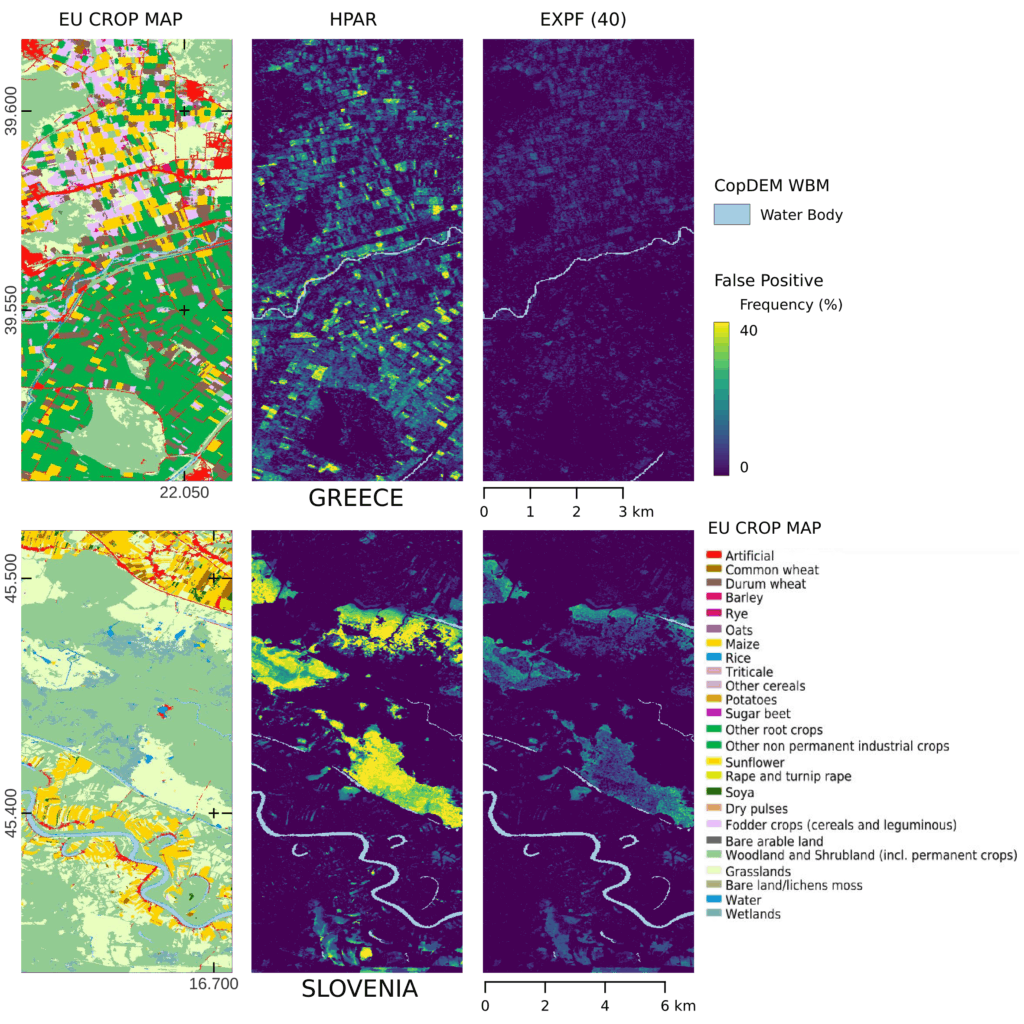
Mapping flood events with Synthetic Aperture Radar (SAR) data is becoming increasingly important due to its spatiotemporal coverage and independence from weather and lighting conditions.
The Copernicus Emergency Management Service, the Earth Observation component of the European Union’s space program, uses a global flood mapping algorithm that relies on Bayesian Inference. This algorithm compares a SAR image to a reference image that shows no flooding, which was created using a harmonic model trained on historical data to reflect seasonal conditions. However, this method has a limitation: it does not account for recent changes in the environmental conditions. This can lead to an overestimation of flood areas.
To improve this, we have developed an exponential filter that estimates the no-flood reference by giving more weight to the most recent backscatter observations. Using a new flood mapping time-series assessment approach, we tested the exponential filter’s performance against the harmonic model. We analyzed the false positive rates for the flood maps to check the reliability of the automated algorithm during non-flood times.
Our analysis showed that false positive rates increased due to certain environmental factors and pointed out agricultural overestimation, which depends on crop type and agricultural practices, as a significant issue. The time-series comparisons of the no-flood models showed that the TU Wien flood mapping algorithm with the exponential filter reduces false positives in non-flooded scenes. Based on higher accuracy scores, it performed better than the harmonic model in most flooded areas tested. But the exponential filter struggles in areas with long-lasting floods, indicating a need for further improvement. Overall, the exponential filter shows promise for better global and near-real-time flood mapping.
This proposed improvement is expected to be implemented in the existing TU Wien algorithm and, later on, in the Copernicus Emergency Management Global Flood Monitoring initiative.
Authors:
Mark Edwin Tupas (Department of Geodetic Engineering, College of Engineering, University of the Philippines Diliman), Florian Roth (Technische Universität Wien), Bernhard Bauer-Marschallinger (Technische Universität Wien) and Wolfgang Wagner (Technische Universität Wien | Earth Observation Data Centre)
Read the full paper: https://doi.org/10.1080/15481603.2024.2427304