
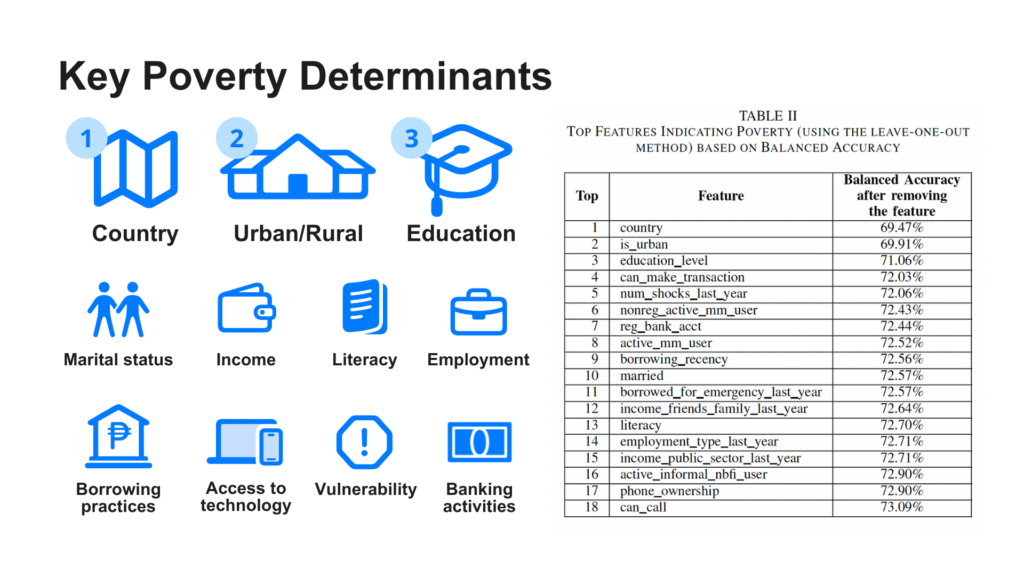
Using machine learning, study finds that key factors influencing poverty include country, whether people live in urban or rural areas, and their level of education
10 Apr 2026
Relying only on income to determine poverty is not enough to fully understand someone’s well-being. Other factors, such as where people live, their education, and the quality of their jobs, also matter. In the Philippines, it has been difficult to accurately identify who is truly in need, which has caused a gap between the people the programs are meant to help and those who actually benefit.
This study suggests using machine learning, specifically a Naïve Bayes classifier, to improve how poverty is assessed. By analyzing various social and economic factors, this approach could help policymakers make better decisions and use resources more effectively for poverty reduction programs. The Naïve Bayes model was compared to other machine learning models and performed better at predicting who might be living in poverty.
The study found that key factors influencing poverty include the country, whether people live in urban or rural areas, and their education level. The Naïve Bayes model correctly identified poverty status 69% of the time with new, unseen data. These findings show how machine learning can play an important role in tackling complex social issues like poverty.
The study aims to address the significant mismatch between the criteria used in the national targeting system for identifying the poorest families and the actual beneficiaries. Additionally, it seeks to fill a noticeable gap in the application of AI projects specifically targeting the United Nations Sustainable Development Goal of No Poverty by proposing an innovative approach to poverty assessment using machine learning techniques.
By employing a Naïve Bayes classifier and exploring various attributes influencing poverty, this research aims to inform policy decisions and optimize resource allocation for poverty alleviation programs. Furthermore, it contributes to the broader discourse on poverty assessment methods, advocating for a shift toward a more holistic, data-driven approach. By leveraging machine learning techniques, this study aspires not only to refine poverty classification but also to empower policymakers with tools that can adapt to the evolving dynamics of socioeconomic challenges.
Authors: Jamlech Iram N. Gojo Cruz (Institute of Computer Science, University of the Philippines Los Baños | National Graduate School of Engineering, University of the Philippines Diliman) and Prospero C. Naval (Department of Computer Science, University of the Philippines Diliman)
Read the full paper: https://ieeexplore.ieee.org/abstract/document/10674408