
A notation system for teaching arnis strikes and movements has been developed

26 May 2026
The indigenous martial art of arnis is recognized as the national sport of the Philippines. Known regionally as eskrima, kali, garrote, pananandata, or kaliradman, the practice involves distinct twirling and swinging motions used for offensive and defensive striking, thrusting, and parrying. Training is conducted either empty-handed or with one to two sticks.

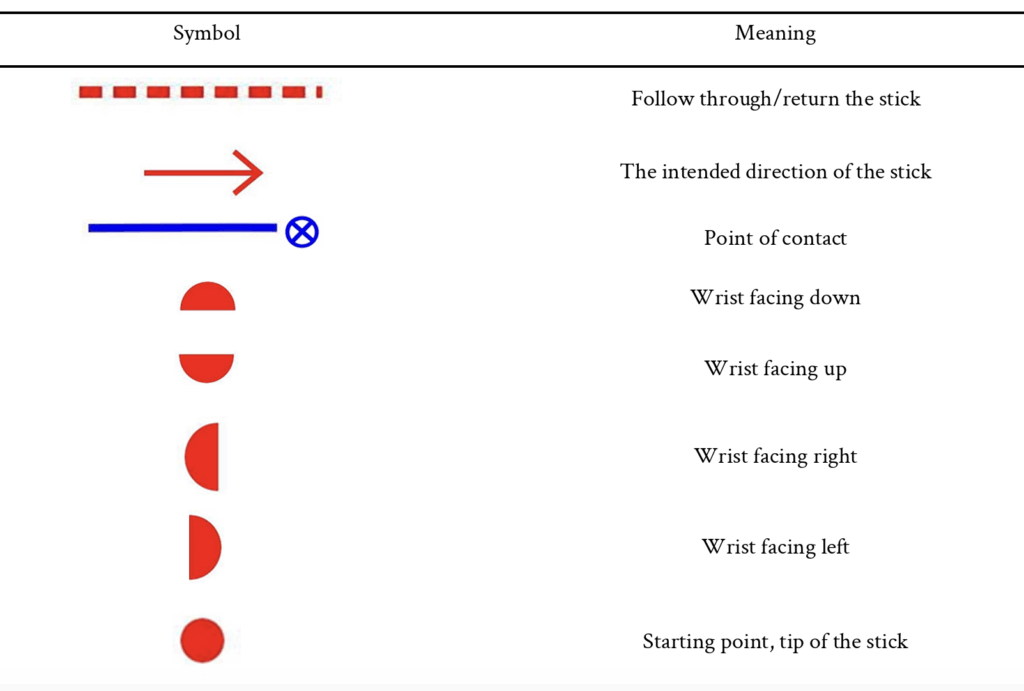
Because live demonstrations can hardly accurately portray arnis strikes and movements, physical education (PE) teachers often have to supplement them with printed instructions accompanied by pictures of the various strike postures.  But, even then, these hardly capture the fullness of the arnis strikes, and the insufficiency hinders learners from replicating the strikes consistently and accurately. A widely accessible, easy-to-use, and intuitive instructional manual would make life easier for arnis teachers and learners.  However, such a manual does not yet exist because no notation system is available that can concisely and intuitively describe each movement while remaining simple enough for PE students to understand.  So, I carried out this research project in pursuit of such a notation system. In this paper, I outline the methods and processes that led to a suitable, although preliminary and rudimentary, notation system for arnis.  Data for the notation were collected through ethnographic methods, particularly participant observation and immersion, as well as personal interviews, video recording, photography, journaling, and note-taking. Four grandmasters of a well-respected arnis club provided observational data, which were converted into notation using the proposed symbol set. A total of seven grandmasters validated the final output.

Before this notation system, none existed that could adequately represent the said strikes and movements using a culture-agnostic symbol system without overwhelming its users with complexity.  Ethnography played a major role in collecting observational data on the various strikes.  Although the notation system is still in its infancy, it holds high potential for further development, expansion, and maturity so that it can reach a form that not only becomes standard but also comprehensive in covering all facets of every arnis strike while still being simple, intuitive, and accessible.  To some extent, this study paves the way for the preservation of arnis as a precious artifact of Filipino cultural heritage and for greater access to a pedagogical tool and method for systematic analysis and documentation of indigenous martial arts.

Author: Joan Grace E. Pacres (College of Social Sciences, University of the Philippines Cebu)

Read the full paper: https://doi.org/10.18573/mas.223

A notation system for teaching arnis strikes and movements has been developed

The indigenous martial art of arnis is recognized as the national sport of the Philippines. Known regionally as eskrima, kali, garrote, pananandata, or kaliradman, the practice involves distinct twirling and swinging motions used for offensive and defensive striking, thrusting, and parrying. Training is conducted either empty-handed or with one to two sticks.

Because live demonstrations can hardly accurately portray arnis strikes and movements, physical education (PE) teachers often have to supplement them with printed instructions accompanied by pictures of the various strike postures.  But, even then, these hardly capture the fullness of the arnis strikes, and the insufficiency hinders learners from replicating the strikes consistently and accurately. A widely accessible, easy-to-use, and intuitive instructional manual would make life easier for arnis teachers and learners.  However, such a manual does not yet exist because no notation system is available that can concisely and intuitively describe each movement while remaining simple enough for PE students to understand.  So, I carried out this research project in pursuit of such a notation system. In this paper, I outline the methods and processes that led to a suitable, although preliminary and rudimentary, notation system for arnis.  Data for the notation were collected through ethnographic methods, particularly participant observation and immersion, as well as personal interviews, video recording, photography, journaling, and note-taking. Four grandmasters of a well-respected arnis club provided observational data, which were converted into notation using the proposed symbol set. A total of seven grandmasters validated the final output.

Before this notation system, none existed that could adequately represent the said strikes and movements using a culture-agnostic symbol system without overwhelming its users with complexity.  Ethnography played a major role in collecting observational data on the various strikes.  Although the notation system is still in its infancy, it holds high potential for further development, expansion, and maturity so that it can reach a form that not only becomes standard but also comprehensive in covering all facets of every arnis strike while still being simple, intuitive, and accessible.  To some extent, this study paves the way for the preservation of arnis as a precious artifact of Filipino cultural heritage and for greater access to a pedagogical tool and method for systematic analysis and documentation of indigenous martial arts.

Author: Joan Grace E. Pacres (College of Social Sciences, University of the Philippines Cebu)

Read the full paper: https://doi.org/10.18573/mas.223