Combining Design Thinking and Agile-Scrum enhances student learning outcomes, creativity, and collaboration
10 Jun 2026
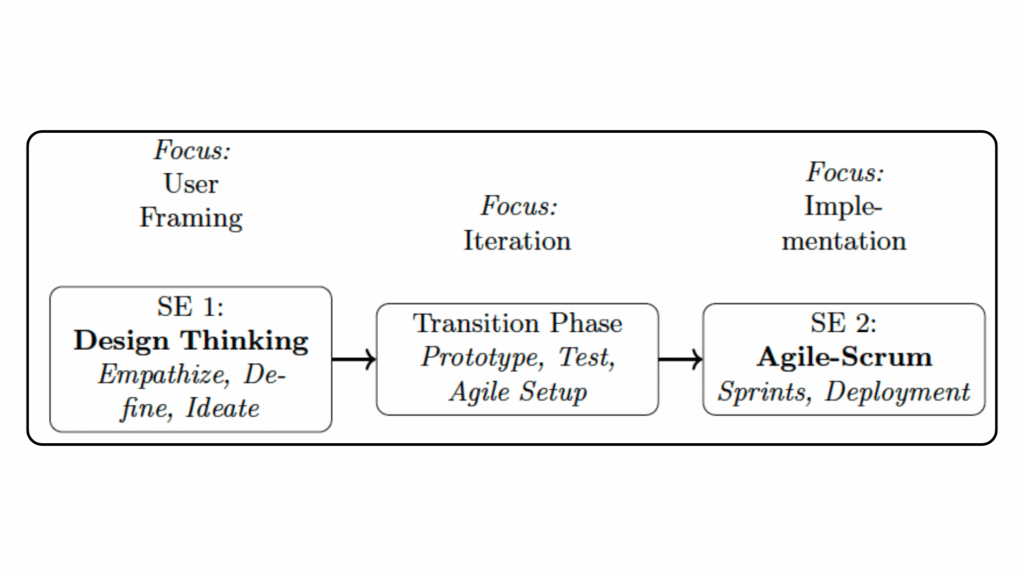
Traditional software engineering education heavily emphasizes technical coding skills, but the evolving tech industry demands creativity, collaboration, and user empathy. Our research investigated how integrating Design Thinking (DT) alongside structured Agile-Scrum practices within a project-based curriculum can bridge this gap for undergraduate students.
We found that adopting a phased hybrid model–focusing on empathy-driven problem framing in the design stage and iterative sprint execution during development–significantly enhances student learning outcomes. Across 65 participating computer science students, the intervention resulted in high performance levels in user-centered design, innovation, and ideation. DT adoption significantly improved participant understanding of user demographics and catalyzed robust cross-functional team collaboration. Collaborative tools like Trello and GitHub proved essential for maintaining transparency, parallel development, and task coordination among teams.
However, the exploratory nature of Design Thinking also introduced distinct challenges under Agile time constraints, with students frequently encountering heavy time pressures and uneven workload distribution during the fast-paced development sprints. To mitigate these bottlenecks, our findings highlight the necessity of adaptive sprint pacing, structured peer evaluations, and continuous industry mentorship to maintain a healthy balance between open-ended creativity and strict engineering timelines.
The findings highlight the value of combining DT and Agile in a structured curriculum and recommend adaptive pacing, peer evaluations, and ongoing mentorship to optimize learning outcomes and prepare students for real-world software development.
This study informs pedagogical practice, enabling computing educators and academic administrators to design a more responsive, interdisciplinary, and industry-aligned software engineering curriculum.
Authors: Fernand G. Bernardez (College of Social Sciences, University of the Philippines Cebu), Darmae M. Tan (College of Science, University of the Philippines Cebu), and Paula E. Mayol (College of Science, University of the Philippines Cebu)
Read the book chapter: https://link.springer.com/chapter/10.1007/978-3-032-06634-3_4
View on YouTube: https://www.youtube.com/watch?v=EqLN5dkSCDk