
Mindoro was already a vibrant center for human movement and early innovation 35,000 years ago
22 Jun 2026
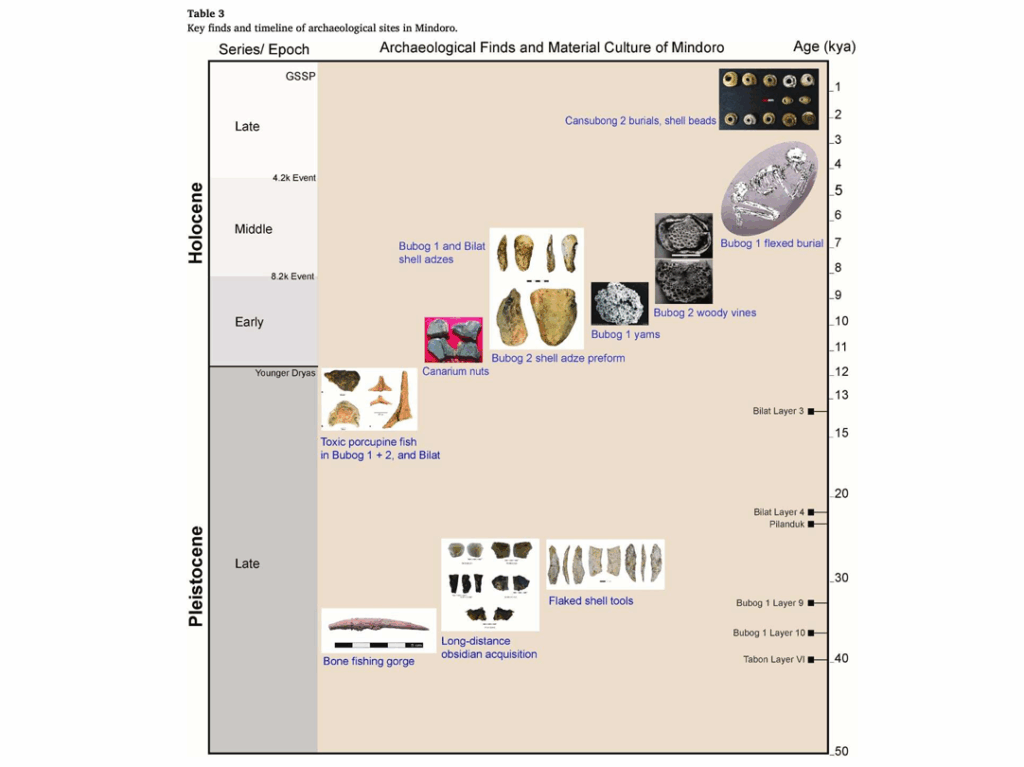
In a bold reimagining of Southeast Asia’s prehistory, this research reveals that the Philippine island of Mindoro was a hub of human innovation and migration as far back as 35,000 years ago. It presents a wealth of data and materials from the Mindoro Archaeology Project, including some of the oldest evidence of the presence of anatomically modern humans (Homo sapiens) in the Philippine archipelago, in Occidental Mindoro — particularly on Ilin Island; San Jose; and Sta. Teresa, Magsaysay. Mindoro, like most of the main Philippine islands except for Palawan, was never connected to mainland Southeast Asia, neither by land bridges nor by ice sheets, and sea-crossings were always necessary to reach it. This likely spurred the development of sophisticated technologies for traversing and surviving this environment.
A variety of finds such as human remains, animal bones, shells, and tools made from stone, bone and shell show that Mindoro’s early inhabitants successfully harnessed both terrestrial and marine resources such that, over 30,000 years ago, they already possessed seafaring capabilities and specific fishing skills that enabled them to catch predatory open-sea fish species, such as bonito and shark, and to establish connections with distant islands and populations in the vast maritime region of Wallacea. These suggest that Mindoro and nearby Philippine islands were part of an extensive maritime network that existed already during the Stone Age and facilitated cultural and technological exchange between early human populations across Island Southeast Asia for many millennia.
The investigation and excavation of caves and rockshelters located at the southern end of Occidental Mindoro produced significant artefacts, data, and information related to the initial arrival and colonization of the Philippine archipelago by anatomically modern humans. The sites provided several indications for the increasing adaptation to maritime environments and delivered evidence for their behavioural and technological complexity. Mindoro lies along a direct route to reach the main islands of the Philippines coming from the Asian mainland via Borneo and Palawan.
Since 2010, surveys conducted in the karstic regions of Ilin Island and Sta. Teresa, Magsaysay have mapped and explored over 40 caves and rockshelters. Particularly the sites of Bubog 1, Bubog 2, Cansubong 2 Cave, and Bilat Cave, have delivered cultural and biological materials that chronicle human habitation and adaptation to maritime and coastal environments over a period of 35–40,000 years. Early islanders in the region intensively foraged for molluscs and other marine invertebrates along the coast, employed different techniques to catch a variety of reef and pelagic fish as well as terrestrial animals, and were embedded in maritime networks with access to transfer routes, through which technology, information, and ideologies were disseminated over long distances and across Island Southeast Asia (ISEA) and possibly also reaching the Southeast Asian mainland. The results of the archaeological research in Mindoro contribute to our understanding of the processes of human island adaptation, complement ongoing research on the peopling of Southeast Asia, and enhance current knowledge of prehistoric subsistence strategies across the region.
Authors: Alfred F. Pawlik (Department of Sociology and Anthropology, Ateneo de Manila University | TRACES ASIA | Department of Early Prehistory and Quaternary Ecology, Eberhard Karls Universität Tübingen), Riczar B. Fuentes (Department of Sociology and Anthropology, Ateneo de Manila University | TRACES ASIA | Department of Palaeoanthropology, Senckenberg Research Institute and Natural History Museum), Marie Grace Pamela G. Faylona (College of Advanced Studies, Philippine Normal University | Department of Sociology and Behavioral Sciences, De La Salle University | Department of Anthropology, University of the Philippines Diliman), Trishia Gayle R. Palconit (Sezione di Scienze Preistoriche ed Antropologiche, Dipartimento di Studi Umanistici, Università degli Studi di Ferrara), and Tanya Uldin (Department of Sociology and Anthropology, Ateneo de Manila University | TRACES ASIA)
Read the full paper: https://doi.org/10.1016/j.ara.2025.100616