
Pigmented rice holds strong potential to improve the technological, nutritional, and sensory properties of bakery products and snacks
06 Jul 2026
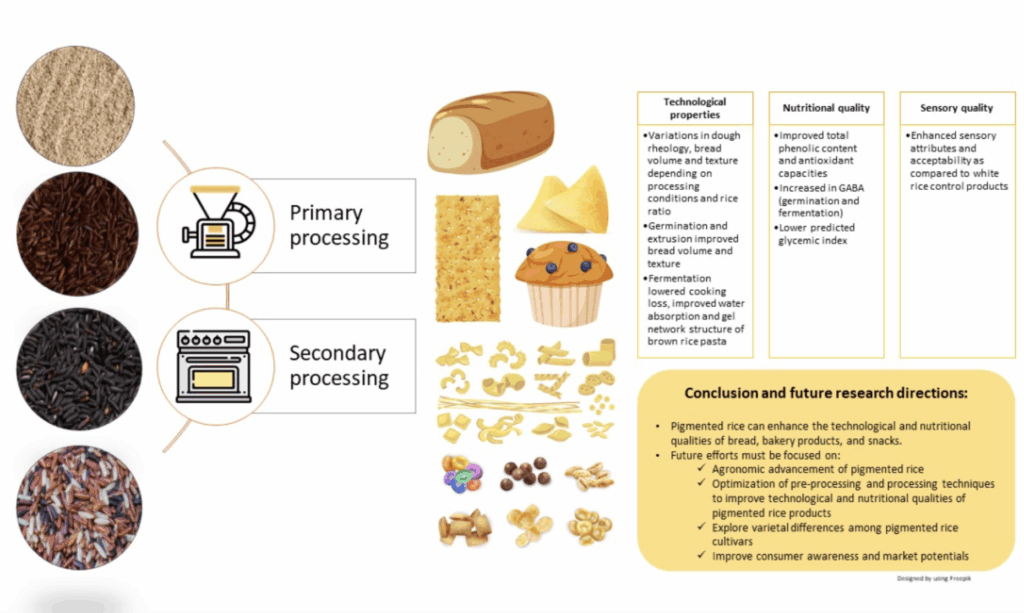
Rice is a vital global crop, supplying 60–70% of the daily caloric intake for more than two billion people across Asia. Similarly, bread and pasta are essential pillars of the global diet. While significant effort has been made to enhance the nutritional value of bakery products using functional ingredients, alternative technologies, and pigmented wholegrains, rice-based applications still rely almost exclusively on polished white rice. The food industry favors white rice for its gluten-free (GF) profile and neutral flavor, leaving the potential of pigmented rice largely uninvestigated. This review aims to bridge this gap by exploring the integration of wholegrain pigmented rice into bread, bakery items, and snacks. Specifically, we evaluate how pigmented rice varieties influence the technological, nutritional, and sensory properties of these final food products.
Rich in bioactive compounds, pigmented rice offers superior antioxidant capacity compared to non- pigmented rice. Pigmented rice refers to naturally colorful rice varieties, such as black and red, that get their vibrant hues from high concentrations of beneficial plant compounds called anthocyanins and flavonoids.
Processing methods like milling, parboiling, thermal treatments (e.g., extrusion cooking), and biobased approaches (e.g., germination and fermentation) impact the technological and nutritional properties of pigmented rice. All products with added pigmented rice showed improved total phenolic content and antioxidant capacities. Extrusion cooking improved technological properties of dough, bread, and bakery products by modifying the pasting properties of rice. Germination and fermentation enhanced bakery products’ nutritional value by increasing gamma-aminobutyric acid (GABA) levels.
Pigmented rice flour can enhance the volume, crumb firmness, and elasticity of GF bread, especially with ohmic heating. It improved sensory qualities and consumer acceptance of various baked products and extruded snacks. While pigmented rice-based pasta and noodles had compromised cooking qualities, germination improved noodle cooking qualities. Pre-processing techniques like parboiling and micronisation show potential for improving pigmented rice’s technological properties and warrant further study. In conclusion, pigmented rice can enhance the technological and nutritional qualities of bread, bakery products, and snacks. Future research should focus on agronomic advancement, optimization of pre-processing and processing techniques, exploring varietal differences among pigmented rice cultivars, and promotion of consumer awareness and market potential.
Authors: Gemaima C. Evangelista (Department of Biotechnology and Food Science, Institute of Food Technology, BOKU-University | Institute of Human Nutrition and Food, University of the Philippines Los Baños) and Regine Schönlechner (Department of Biotechnology and Food Science, Institute of Food Technology, BOKU-University)
Read the full paper: https://doi.org/10.3390/app15126698