
A new “virtual forest” simulation models how changing forest management impacts ecosystems, economies, and communities
26 Jun 2026
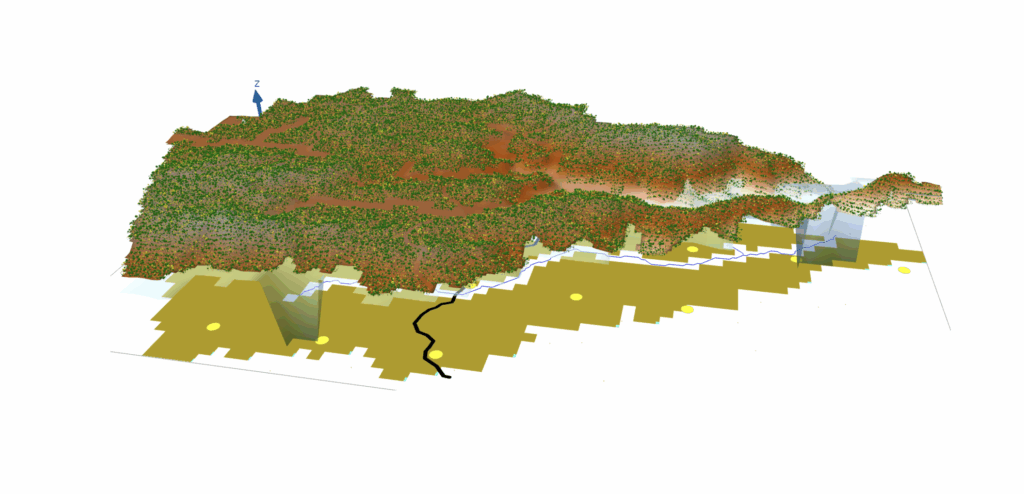
The Philippines has lost much of its natural forest due to decades of logging and land conversion, creating a shortage of wood for homes, furniture, and other needs. One solution is industrial tree plantations—areas where trees are planted, harvested, and replanted in cycles. These plantations can supply timber without further harming remaining forests, but managing them well is challenging.
Our study developed LUNTIAN, a computer simulation that works like a “virtual forest.” It doesn’t just track tree growth—it also includes people and their decisions, such as investors choosing where to put money, local workers seeking jobs, and forest patrol officers preventing illegal logging. By simulating their actions alongside natural processes like tree growth and water availability, we can see how management changes affect the forest, economy, and community over many years. We tested different scenarios, adjusting factors like harvest timing, profit sharing, and hiring levels. In the best case, the forest grew 55% more trees over 17 years while providing steady jobs, generating millions in income for both the university and investors, and eliminating illegal cutting.
In short, this research is significant because it provides a practical, adaptable, and scientifically grounded framework for exploring how industrial tree plantations can be managed to achieve simultaneous environmental, economic, and social sustainability in the Philippines.
This research is important because it gives decision-makers a safe, low-cost way to explore “what-if” situations before acting in the real world. With careful planning, industrial tree plantations can help restore forests, support rural livelihoods, and strengthen the country’s wood supply.
Key points of significance include:
- Integration of ecology and socio-economics – Unlike traditional forestry models that focus
mainly on tree growth and stand dynamics, LUNTIAN embeds human factors (investor
behavior, labor dynamics, enforcement, informal harvesting) as core, interacting
components of the system. - Evidence-based decision support – The model can test and compare different plantation
management strategies under realistic constraints, helping stakeholders balance ecological
regeneration, economic viability, and social inclusion without high-cost or risky field trials. - Demonstrated sustainability potential – Under optimized conditions, simulations showed a
55% increase in tree population over a 17-year rotation, profitable returns for both the
university and investors, stable employment for local communities, and elimination of
unauthorized harvesting. - Policy and planning relevance – Results offer insights into how parameter adjustments
(e.g., rotation length, investor profit share, community labor size, enforcement levels) can
improve outcomes, supporting better policy design for reforestation, rural livelihoods, and
sustainable wood production. - Innovative methodological approach – By embedding socio-economic processes directly
into a spatially explicit simulation, LUNTIAN represents a more holistic way of analyzing
managed forest systems, potentially applicable to other contexts facing similar ecological
and social challenges.
Authors: Zenith Arnejo (UMR 5505, Institut de Recherche en Informatique de Toulouse (IRIT), Université Toulouse Capitole | Institute of Computer Science, University of the Philippines Los Baños), Benoit Gaudou (UMR 5505, Institut de Recherche en Informatique de Toulouse (IRIT), Université Toulouse Capitole), Mehdi Saqalli (UMR 5602, Géographie de l’Environnemment (GEODE), Centre National de la Recherche Scientifique (CNRS), Université Toulouse Jean Jaures), and Nathaniel Bantayan (Institute of Renewable Natural Resources, University of the Philippines Los Baños)
Read the full paper: https://www.mdpi.com/1999-4907/16/8/1293