ASEAN would benefit from a shared regulatory framework for business competition, particularly in relation to artificial intelligence
19 Feb 2026
Big tech companies are facing more and more scrutiny over their business practices, especially in the US and Europe, where there is concern about monopolies and fair competition. But in Southeast Asia (ASEAN)—even though it is the world’s fifth-largest economy—this issue has not received much attention.
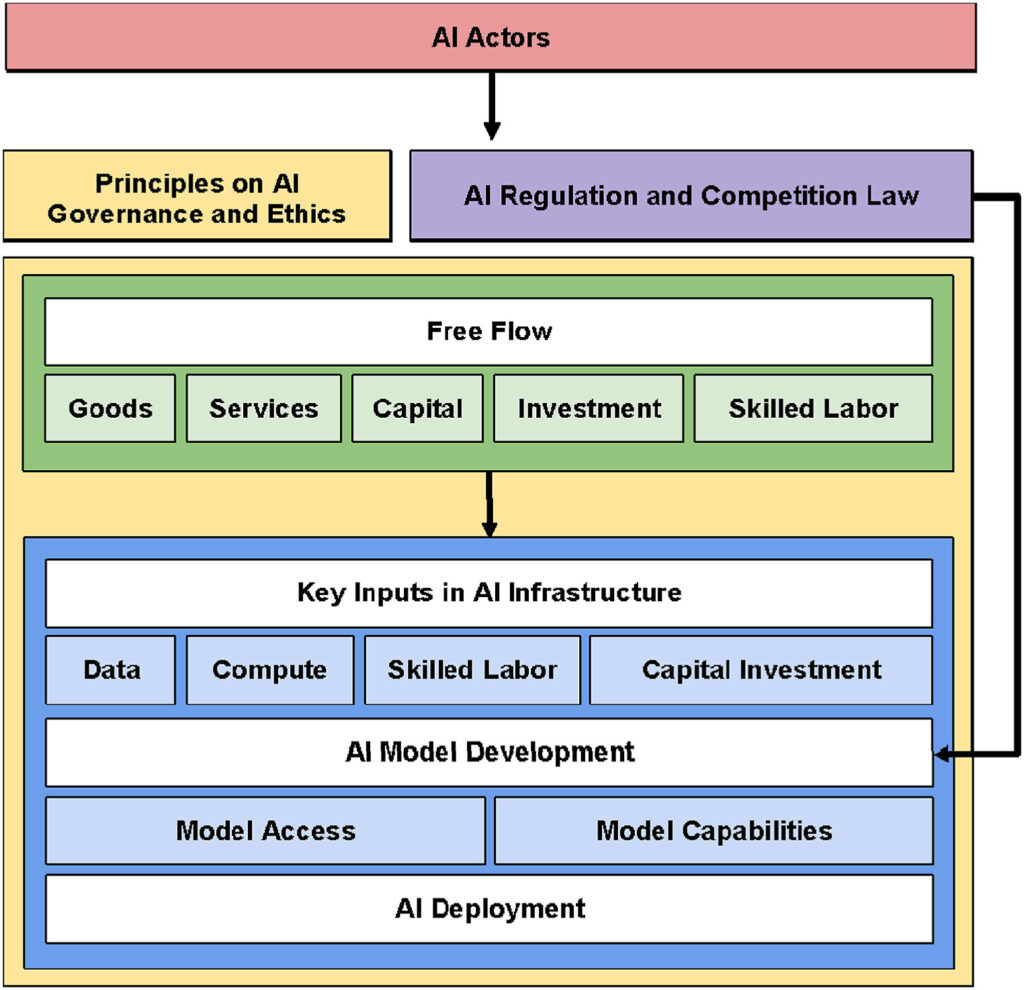
This article suggests that ASEAN could benefit a lot from creating a shared set of rules about business competition, especially when it comes to artificial intelligence (AI). Establishing a unified competition law framework in Southeast Asia has the potential to significantly benefit the region’s AI industry by simplifying the regulatory landscape, fostering collaboration, and encouraging innovation. Integrating competition law principles into existing frameworks, such as the ASEAN Guide on AI and Ethics, the ASEAN Regional Guidelines on Competition Policy, and the ASEAN Competition Action Plan, offers a pragmatic and feasible path forward. This approach could harmonize ethical and competitive practices across the region without imposing excessive regulatory burdens. If countries in the region had the same laws, it would be easier for AI companies to operate across borders, encourage healthy competition, and protect consumers.
At the same time, AI is pervasive and cross-cutting across various domains. Because of its many potential applications, the AI industry, with its reliance on critical inputs such as data, compute, and model, can serve as a test case for the application of competition law in ASEAN, particularly in other digital market domains like digital payments and e-commerce in general. By addressing issues such as dependency relationships in mergers, acquisitions, and partnerships, as well as providing policy support for digital services and telecommunications infrastructure, the region can help ensure equitable access to key resources and prevent market concentration. Regulating access to proprietary data, compute infrastructure, and AI models through fair and non-exclusive licensing terms can foster greater inclusivity and competition in the industry. Public-private initiatives, such as data-sharing platforms, can further empower smaller firms and startups to compete independently. These factors are crucial in strengthening the free flow of data, compute, and model in the region.
The article also proposes some practical guidelines that could be added to this shared framework, helping ensure AI is developed and used in a fair and responsible way. Clear regulations targeting anti-competitive practices, coupled with initiatives to promote fair access to critical inputs for the industry, can help ensure that the benefits of AI are shared across all Member States, paving the way for a thriving, inclusive, and forward-looking AI ecosystem. Overall, this could boost innovation, support fairer business practices, and help grow the region’s economy.
Authors: Chad Patrick Osorio (Law Group, Wageningen University and Research | School of Environmental Science and Management, University of the Philippines Los Baños) and Jamlech Iram Gojo Cruz (Institute of Computer Science, University of the Philippines Los Baños)
Read the full paper: https://www.sciencedirect.com/science/article/pii/S0308596125000503