
Researchers develop a method for creating maps that show how national cultures have evolved over time

22 Jan 2026
Culture is understood as a shared and negotiated system of meaning that people learn and practice by interpreting their experience and translating it into palpable social behavior. It is observed in art, knowledge, language, religion, tradition, or in a set of values representing a lasting belief that a specific mode of conduct or end-state of existence is personally or communally preferable.

Efforts at quantifying cultural variations mostly rely on survey responses. The Integrated Values Survey (IVS) is an integration of the World Values Survey (WVS) and European Values Survey data, which presently consists of seven survey waves (average duration: 5.43 years) successively conducted from 1981 (start of Survey Wave 1) to 2022 (end of Wave 7). The WVS provides a 42-year collection of data sets gathered from more than 120 countries. Easy access to the IVS data has enabled the conduct of several independent investigations on cross-cultural variations in socio-politics, economics, education, health, and others. The IVS data can be downloaded from the WVS (worldvaluessurvey.org) and GESIS (gesis.org) websites. Survey 8 is ongoing in different countries.

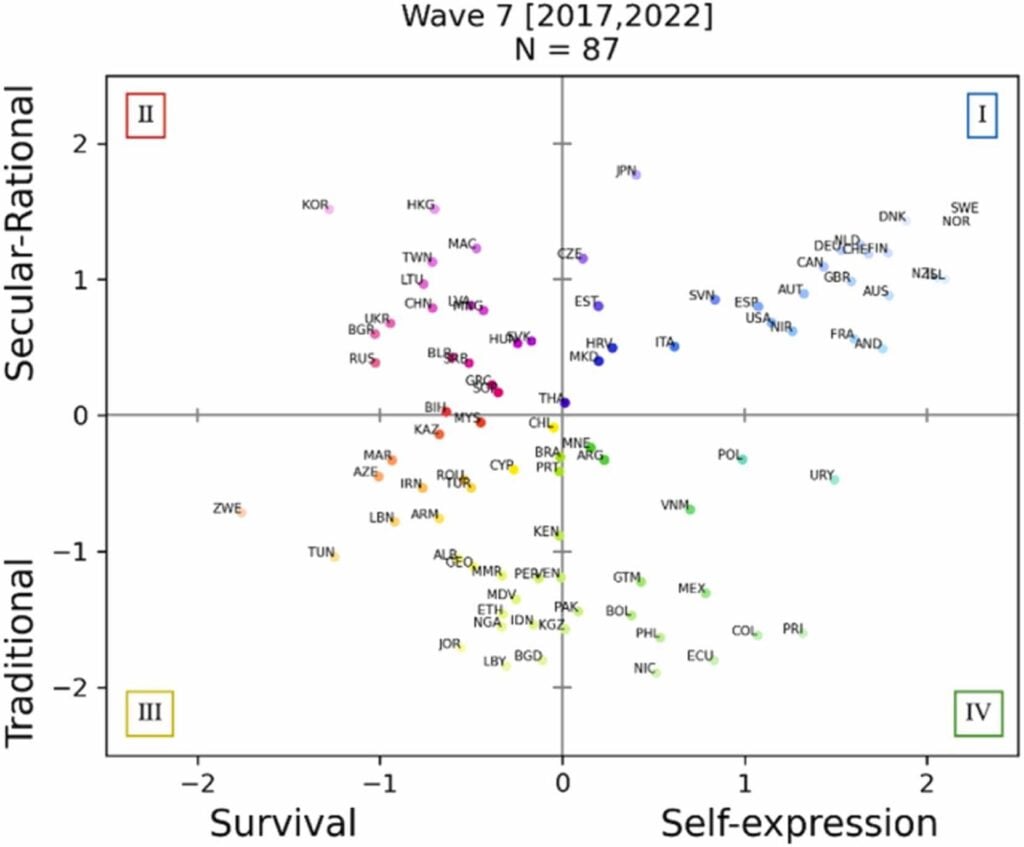
While temporal changes in cross-cultural variations were already measured in early studies using value differences, they were only conducted at the cross-country level. Here, we demonstrate a method for deriving pairs of time-resolved two-dimensional culture maps from IVS. A pair consisting of a cross-country map and a survey respondent-level map is extracted from each wave via principal component analysis (PCA). In the cross-country map, countries are represented as points, while in the respondent-level map of a country, the survey respondents are depicted as points distributed about a mean location. The cross-country map reveals the cultural variations of the participating countries while the respondent-level map of a country shows the variations of its national population as represented by the randomly selected respondents. The information content of each map is unique and complementary.

The study found, among others, that the degree of socio-economic development rises with increasing secular-rational and self-expression value scores, consistent with earlier theories. Traditional societies place greater importance on religion, strong family ties, respect for authority, and traditional values. In contrast, secular-rational societies place less emphasis on these. Societies that focus on survival values prioritize economic and physical security, while those with strong self-expression values emphasize environmental protection, gender equality, and active participation in social and economic life.

The capability to accurately detect subtle differences in cultural values, specifically in how they evolve with time, would allow different people to understand each other better, thereby avoiding costly conflicts between legislators, policymakers, and public administrators to guide and fine-tune their decisions and actions to achieve the desired results for their stakeholders.

Authors: John Lawrence Euste (The Abdus Salam International Centre for Theoretical Physics & Scuola Internazionale Superiore di Studi Avanzati | National Institute of Physics, University of the Philippines Diliman), Hannah Christina Arjonillo (National Institute of Physics, University of the Philippines Diliman), and Caesar Saloma (National Institute of Physics, University of the Philippines Diliman)

Read the full paper: http://10.1016/j.physa.2024.130317

Researchers develop a method for creating maps that show how national cultures have evolved over time

Culture is understood as a shared and negotiated system of meaning that people learn and practice by interpreting their experience and translating it into palpable social behavior. It is observed in art, knowledge, language, religion, tradition, or in a set of values representing a lasting belief that a specific mode of conduct or end-state of existence is personally or communally preferable.

Efforts at quantifying cultural variations mostly rely on survey responses. The Integrated Values Survey (IVS) is an integration of the World Values Survey (WVS) and European Values Survey data, which presently consists of seven survey waves (average duration: 5.43 years) successively conducted from 1981 (start of Survey Wave 1) to 2022 (end of Wave 7). The WVS provides a 42-year collection of data sets gathered from more than 120 countries. Easy access to the IVS data has enabled the conduct of several independent investigations on cross-cultural variations in socio-politics, economics, education, health, and others. The IVS data can be downloaded from the WVS (worldvaluessurvey.org) and GESIS (gesis.org) websites. Survey 8 is ongoing in different countries.

While temporal changes in cross-cultural variations were already measured in early studies using value differences, they were only conducted at the cross-country level. Here, we demonstrate a method for deriving pairs of time-resolved two-dimensional culture maps from IVS. A pair consisting of a cross-country map and a survey respondent-level map is extracted from each wave via principal component analysis (PCA). In the cross-country map, countries are represented as points, while in the respondent-level map of a country, the survey respondents are depicted as points distributed about a mean location. The cross-country map reveals the cultural variations of the participating countries while the respondent-level map of a country shows the variations of its national population as represented by the randomly selected respondents. The information content of each map is unique and complementary.

The study found, among others, that the degree of socio-economic development rises with increasing secular-rational and self-expression value scores, consistent with earlier theories. Traditional societies place greater importance on religion, strong family ties, respect for authority, and traditional values. In contrast, secular-rational societies place less emphasis on these. Societies that focus on survival values prioritize economic and physical security, while those with strong self-expression values emphasize environmental protection, gender equality, and active participation in social and economic life.

The capability to accurately detect subtle differences in cultural values, specifically in how they evolve with time, would allow different people to understand each other better, thereby avoiding costly conflicts between legislators, policymakers, and public administrators to guide and fine-tune their decisions and actions to achieve the desired results for their stakeholders.

Authors: John Lawrence Euste (The Abdus Salam International Centre for Theoretical Physics & Scuola Internazionale Superiore di Studi Avanzati | National Institute of Physics, University of the Philippines Diliman), Hannah Christina Arjonillo (National Institute of Physics, University of the Philippines Diliman), and Caesar Saloma (National Institute of Physics, University of the Philippines Diliman)

Read the full paper: http://10.1016/j.physa.2024.130317