
Using the quantum graph model, researchers show that only three kinds of Dirac points can exist for all periodic quantum graphs associated with Archimedean tilings
08 Sep 2026
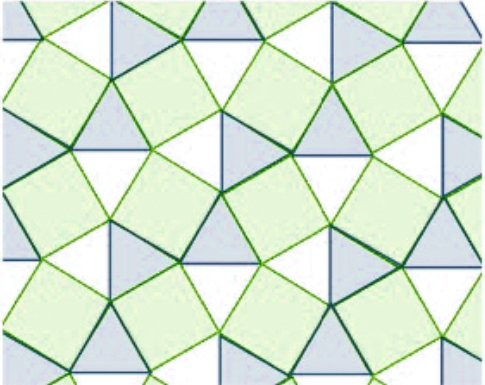
This research explores a special property of materials like graphene that allows them to conduct electricity in unusual ways. Graphene and similar materials show this behavior because of Dirac points, which are special points where energy levels meet and form cone- shaped structures that control how electrons move. To study them, we used a quantum graph, a mathematical model that represents a material as a network of thin wires connected at junctions. This simple structure still captures the essential physics of how waves and electrons move, making it much easier to analyze than the full complexity of real materials.
Using this approach, we examined all patterns of shapes known as Archimedean tilings, which serve as good models for two-dimensional materials. We found that exactly three kinds of Dirac points can exist in these systems, and no others. Some are rare and fragile, while others are stable and naturally appear, making them especially important in real materials. We also showed that by studying the spectral data, which acts like a fingerprint of the material’s energy, one can reconstruct the underlying forces that shape its behaviour.
This work is important because it gives a complete and rigorous mathematical explanation of Dirac points in these systems while keeping the analysis simple. It connects abstract theory with real materials science and may help researchers design new graphene-like materials for faster electronics, better sensors, and future energy technologies.
Significance:
This research employs the quantum graph model as a powerful yet structurally simple mathematical framework to classify Dirac points in periodic quantum graphs associated with Archimedean tilings, which serve as idealized models for graphene and other two- dimensional carbon allotropes. Quantum graphs reduce complex two-dimensional structures to one-dimensional edges joined at vertices, preserving essential spectral features while greatly simplifying the analysis. This enables rigorous treatment of phenomena that would be analytically intractable in full continuum models, allowing deep spectral insights with minimal computational cost.
Using this framework, we prove that only three classes of Dirac points can occur: those at periodic eigenvalues, those at anti-periodic eigenvalues under special half-periodic potentials, and a more robust class that exists for any even potential. This excludes the existence of other types of Dirac points, providing a complete picture of their spectral behavior. Beyond classification, our study addresses an inverse spectral problem, showing that one can reconstruct the potential of the quantum graph from knowledge of its pure point and absolutely continuous spectra.
Overall, this work highlights how the quantum graph model bridges abstract mathematical theory and physical applications: Archimedean tilings correspond to real materials such as graphene, graphynes, and graphdiynes, where Dirac points dictate unique electronic properties. By distinguishing between unstable and robust Dirac points, our results advance the theoretical understanding of spectral analysis and offer guidance for the design of novel two-dimensional materials.
Authors: Eduardo O. Jatulan (Institute of Mathematical Sciences, University of the Philippines Los Baños) and Chun-Kong Law (Department of Applied Mathematics, National Sun Yat-sen University)
Read the full paper: https://iopscience.iop.org/article/10.1088/1751-8121/ad88bf/meta