What students know about the SDGs and where they learn it directly impacts their commitment to sustainability and their future plans
13 Jul 2026
Despite the international initiatives on integrating the Sustainable Development Goals (SDGs) in educational curricula, there is limited research that looks into how awareness and knowledge on these SDGs are imparted to younger learners. Our study aimed to assess how well senior high school students in the Philippine Science High School System understand and connect with a set of global goals designed to address challenges like poverty, inequality, education, and climate change. Using a survey, we asked students about where they learned about the SDGs, how well they understood them, how these goals are included in their subjects, and how the SDGs influence their daily lives and career plans.
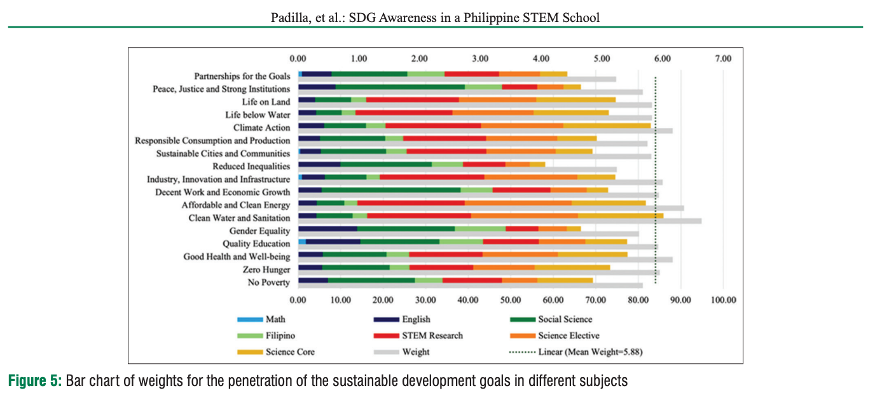
Results showed that most students first learn about the SDGs in school. However, many have only a limited knowledge of how these goals apply over time and in different places around the world. Subjects like Science, Social Science, and STEM Research often include SDG-related content, but others, like Math, tend to leave it out. The study also found that what students know about the SDGs and where they get that information affects how much they care about sustainability and how it influences their future plans.
Based on these findings, the researchers proposed a new education model to help schools do a better job of teaching sustainability in a way that cuts across all subjects. The goal is to help students not only understand global challenges but also prepare them to solve these problems in their future careers.
We deliver the first empirical baseline of how Philippine senior high school students in a science-focused setting grasp and act on the SDGs. Using survey and path-analysis modeling, the study pinpoints the specific curricular channels (STEM Research, Social Science, and Science electives) through which SDG competencies take root and shows how self-reported knowledge and information sources cascade into learning outcomes, personal engagement, and career intent.
The resulting Education for Sustainable Development (ESD) framework provides schools with a data-driven template to embed sustainability thinking across all subjects, including traditionally hard-to-reach areas such as Mathematics. In generating locally validated metrics and an actionable systems model, the work fills a critical gap in global ESD research, offers the DOST and DepEd a concrete tool for tracking SDG integration in basic education, and supports national targets under Ambisyon Natin 2040 and the Philippine Development Plan 2023-2028. The paper therefore advances both educational science and technology policy by guiding the formation of a sustainability-ready STEM workforce.
Authors: Jericho Padilla (Department of Science and Technology, Philippine Science High School – Ilocos Region Campus | College of Education, University of the Philippines Diliman), Jerile Mae Casimiro (Department of Science and Technology, Philippine Science High School – Ilocos Region Campus | Graduate School, Mariano Marcos State University), and Carlo Amigable (College of Medicine, University of the Philippines Manila)
Read the full paper: https://www.icaseonline.net/journal/index.php/sei/article/view/1147