
Using higher-resolution sea surface temperature data enhances typhoon rainfall simulations
24 Jun 2026
The most extreme rainfall that we experience in the Philippines are that from tropical cyclones. The more intense a tropical cyclone is, by definition, it has stronger winds. Also, it will bring more extreme rain in general.
One way to mitigate the potential impacts of strong winds and heavy rains from typhoons is by being able to forecast them accurately ahead of time. To achieve this, numerical weather models are used to predict where and when a typhoon will be before they happen. Numerical weather models are computer models that use observations and complex mathematical equations to solve what will happen to the atmosphere in its future state.
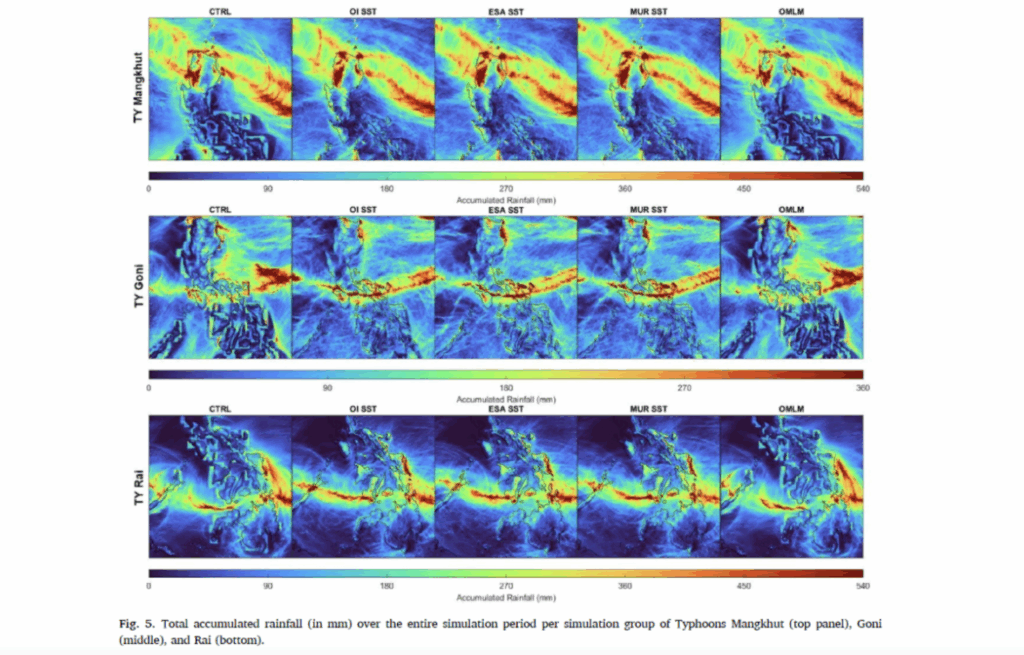
In this study, we used the Weather Research and Forecasting (WRF) model to simulate three historically devastating typhoons – Mangkhut (Ompong in 2018), Goni (Rolly in 2020), and Rai (Odette in 2021) and see what improvements there will be if we use better sea surface temperature data. The temperature of the ocean is what gives intense typhoons the energy needed to intensify, therefore, using better ocean data should, in principle, improve how such typhoons are simulated.
By using sea surface temperature data with higher resolution, rainfall from the typhoons was better simulated and became closer to the observed values, especially along coastal regions. The main advantage of this method is that there is almost no additional computation time needed to implement this. This method can be implemented in operational forecasting in the future, which will incrementally improve weather forecasting in the country.
Authors: Juan Paolo P. Pamintuan (Institute of Environmental Science & Meteorology, University of the Philippines Diliman | Department of Science and Technology – Philippine, Atmospheric, Geophysical, and Astronomical Services Administration) and Gerry Bagtasa (Institute of Environmental Science & Meteorology, University of the Philippines Diliman)
Read the full paper: https://www.sciencedirect.com/science/article/pii/S0377026525000533?via%3Dihub