
Researchers develop a model that helps companies make smarter choices in carbon trading
28 Jan 2026
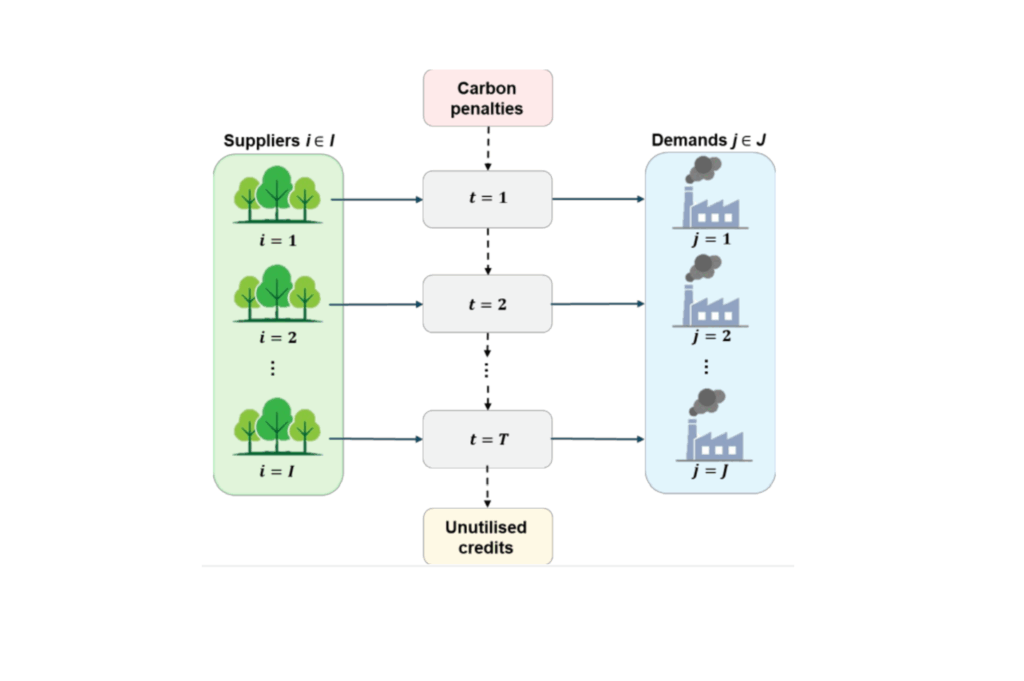
Carbon trading is a mechanism that allows entities to sell or purchase credits which indicate the right to emit carbon dioxide. Carbon credits are permits that let companies release carbon dioxide. Companies can buy and sell these permits to each other. Carbon trading is intended to incentivize industrial reduction of carbon emissions and allow firms to outsource decarbonization if internal measures are not viable. This system rewards companies that pollute less, since they can sell their extra permits. Companies that find it hard to cut pollution can buy permits instead. The credits are deemed retired after they have been redeemed by a given entity. Two main factors control how well this trading works: when permits are available and when companies need them.
This study uses a tool called P-graph to find the best trading plans. The P-graph framework, originally developed for process network synthesis (PNS) problems, was adapted to match carbon credit vendors and buyers under time constraints, assuming that credits can only be sold after they are generated. The tool looks at two costs: fines that companies pay for polluting too much (the carbon penalty incurred by the consumers due to non-compliance with emissions goals), and the money that permit sellers spend to create permits (profit loss experienced by the supplier stemming from the costs associated with generating credits). Tests of this new Carbon Trading P-graph (C_Trading P-graph) model show it helps companies make smarter choices in the carbon permit market. The effectiveness of the proposed model in practical scenarios is demonstrated through three illustrative case studies. This model aids in informed decision-making, facilitating strategic planning in the carbon credit market.
Authors: Bing Shen How (Research Centre for Sustainable Technologies, Swinburne University of Technology), Adeline Shu Ting Tan (Research Centre for Sustainable Technologies, Swinburne University of Technology), Kathleen B. Aviso (Department of Chemical Engineering, De La Salle University, Manila), Maria Victoria MigoSumagang (Department of Chemical Engineering, University of the Philippines Los Baños), Viknesh Andiappan (Research Centre for Sustainable Technologies, Swinburne University of Technology), Raymond R. Tan (Department of Chemical Engineering, De La Salle University, Manila)
Read the full paper: https://doi.org/10.3303/CET24114008