
Scientists develop a model that shows how heat moves during femtosecond pulsed laser ablation
24 Feb 2026
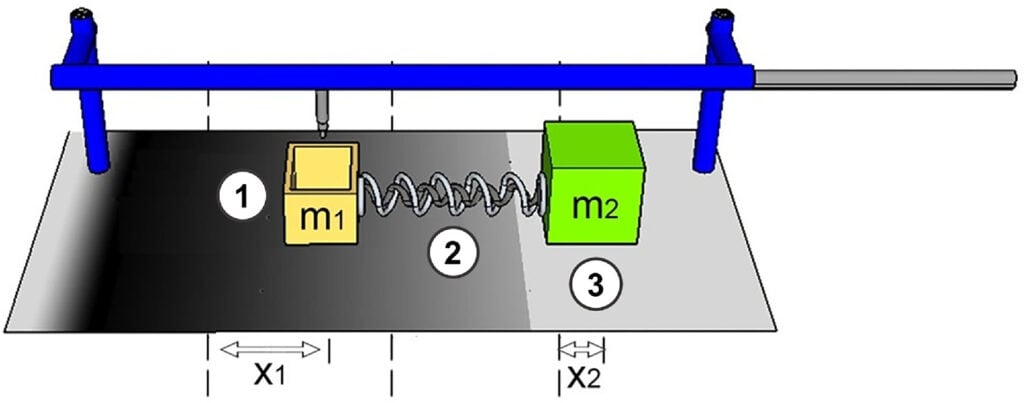
Imagine a laser so fast, it can zap tiny bits of metal in the blink of an eye. This process, called femtosecond pulsed laser ablation (fs-PLA), has various applications, from medicine to manufacturing. But despite its experimental simplicity, the process behind fs-PLA is complicated, covering various optical, mechanical, and thermal processes. Understanding how the heat moves during this process is tricky, even for scientists, and especially for undergraduate students entering the field.
To make the concept easier to understand, we introduced a bridging model using classical and mechanical analog. Specifically, we created a simple analogy using springs and balls, like a toy model. Think of the metal’s tiny particles as two balls connected by a spring. When the laser hits, one ball gets a jolt of energy, and this energy then travels through the spring to the other ball. By observing the balls’ movements, scientists can visualize how heat spreads in the metal. Using this model, the coupled spring-mass oscillator model, provides a clear and intuitive way to understand how heat energy moves within a material during laser ablation. Coupled spring–mass oscillators are, in fact, widely used in undergraduate treatments of classical mechanics, making them a natural and effective starting point for understanding the physical process involved.
The proposed model is not a perfect replica; it simplifies things. But it is a good tool for anyone trying to grasp the basics of this complex laser process, especially for students and new researchers. It is like using a simple diagram to understand complex imagery. While the model has limitations, it offers a valuable tool for learning and preliminary analysis, ultimately contributing to advancements in fields that use fs-PLA. This research helps bridge the gap between complex scientific concepts and everyday understanding, making advanced technology more accessible to students, educators, and anyone curious about the world around them, potentially improving education and fostering deeper understanding.
Authors: Jenny Lou Sagisi (Material Science and Engineering Program, College of Science, University of the Philippines Diliman), Marc Robert Casero (Department of Physical Sciences, Polytechnic University of the Philippines), Andrian Lorenze Floro (Department of Physical Sciences, Polytechnic University of the Philippines), Mcgilvyn Cris Salvador (Department of Physical Sciences, Polytechnic University of the Philippines), Rogelio Dizon (Material Science and Engineering Program, College of Science, University of the Philippines Diliman | Department of Physical Sciences, Polytechnic University of the Philippines), Wilson Garcia (National Institute of Physics, College of Science, University of the Philippines Diliman) and Lean Dasallas (Material Science and Engineering Program, College of Science, University of the Philippines Diliman)
Read the full paper: https://iopscience.iop.org/article/10.1088/1402-4896/ad2f90